


Last month, I wrote about using private annuities (PA) alongside CPF LIFE to build a safe retirement income portfolio. That sparked active discussion on social media. Some felt that since CPF LIFE already pays the best payout per dollar premium in Singapore, you should simply top up your Retirement Account (RA) to the Enhanced Retirement Sum (ERS). Others felt that a substantial Ordinary Account (OA) balance could simply be drawn down over a fixed period, much like an annuity, to complement CPF LIFE. There is no need for a private annuity.
In this article, I used three retiree couples of different wealth levels to show how their portfolios could look like. In this article, I’ll focus only on retirees who want no market risk exposure, just a stable, predictable income without needing to invest. But before I start, a word of warning: this article will be difficult to read because there are a lot of numbers. But if you patiently read it till the end, you will be rewarded with a perspective that you may never have before.
The table is self-explanatory, but a few highlights: Rows 1–3 show each couple’s current OA and RA balances, plus their family’s total income-producing wealth. Under Option 1, I topped up all three couples’ OA using the Voluntary Housing Refund (VHR) and their RA to ERS using the Retirement Sum Topping-Up Scheme (RSTU).
Row 9, under Option 2, shows how each portfolio changes with private annuities (PA) added. For Mr and Mrs A, the only tweak was buying a $100,000 annuity each with cash at age 55. For Mr and Mrs B, instead of topping up their RA to ERS, they each used $220,400 to buy a PA. For Mr and Mrs C, given their limited resources, I believe they should at least hold FRS in their RAs, so no alternative is shown.
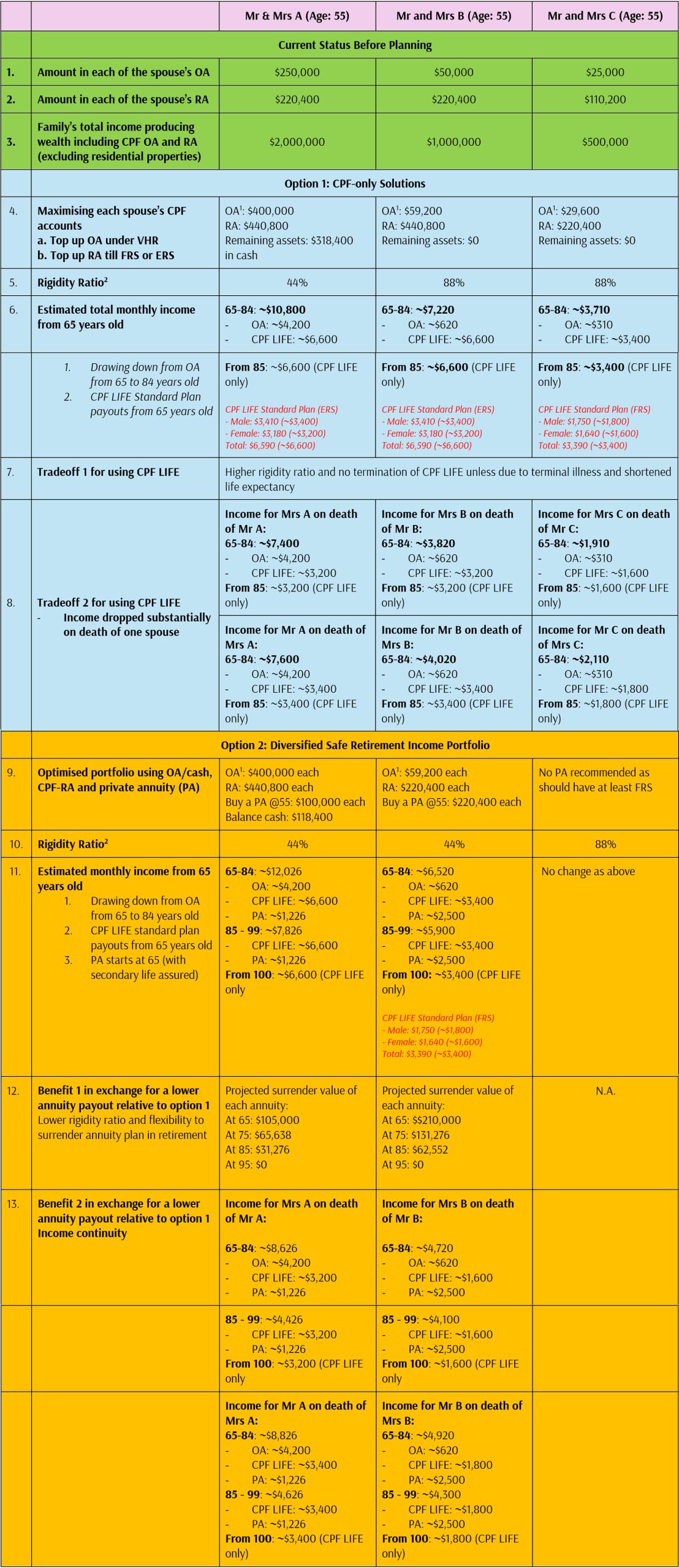
There are a few conclusions we can draw from here:
- Topping up to ERS gives the highest payout (row 6) but raises your rigidity ratio (row 5). Since CPF LIFE can’t be terminated except on terminal illness grounds, a CPF-only solution leaves you no way to access lump sum cash in an emergency.
- The other trade-off: when one spouse passes, their CPF LIFE payout stops, often cutting the survivor’s income sharply. In row 8, Mrs B’s income between 65–84 would drop from ~$7,220 to ~$3,820, which is nearly 50%, even though expenses rarely halve when a spouse passes.
- Rows 9–10 show that adding PA slightly lowers total payout but also lowers the rigidity ratio, giving retirees more liquidity, flexibility, and income continuity. They can terminate the PA and recover its surrender value (row 12). At 65, Mr and Mrs B could still get back ~100% of premiums paid. At 75, after 10 years of payouts, they could cash out ~60% of premiums for a lump sum, dropping their monthly income to $4,020 (just from CPF LIFE and OA), about 62% of before.
- If one spouse passes, the PA income continues for the survivor, cushioning the loss of CPF LIFE. Row 13 shows that instead of dropping to $3,820 under a CPF-only solution, Mrs B would retain $4,720/month, about 65% of their prior combined income.
- Wealthier retirees like Mr and Mrs A can max out their RA to ERS and stay flexible, since they have other income sources. Retirees with fewer resources should think twice. Row 5 shows Mr and Mrs A’s rigidity ratio at just 44%, versus a steep 88% for Mr and Mrs B and C.
- Retirees like Mr and Mrs C should stick to FRS and CPF LIFE, since the highest payout per dollar premium matters most when you need every dollar of income in retirement.
While Providend serves mainly affluent clients, I’m mindful in my writing that not everyone has extensive wealth. Maximising OA and RA balances may suit richer families, since it doesn’t compromise their flexibility or liquidity, but for less wealthy families, an optimised, diversified portfolio better balances income, flexibility, liquidity, and continuation of income for a surviving spouse.
So, none of these solutions should be assumed to be suitable for everyone. Not everyone can top up via VHR, draw their OA to zero, or buy a PA. At the end of the day, what matters is understanding one’s own financial situation, monthly income needs, the desire for flexibility and liquidity, and whether continuing income for a surviving spouse matter.
The writer, Christopher Tan, is Chief Executive Officer of Providend Ltd, Southeast Asia’s first fee-only comprehensive wealth advisory firm and author of the book “Money Wisdom: Simple Truths for Financial Wellness”. He is also a Certified Ikigai Tribe Coach.
The edited version of this article was published in The Business Times on 16 October 2026.
For more related resources, check out:
1. How To Make The Most Of CPF LIFE For Your Retirement
2. Should You Really Invest Your CPF Through LRIS?
3. Frequently Asked Questions About CPF
Being a trusted adviser to our affluent clients for over two decades, we know that our clients need the reliability and sufficiency of investment returns to meet their needs.
We do not charge a fee at the first consultation meeting. If you would like an honest second opinion on your current estate plan, investment portfolio, financial and/or retirement plan, make an appointment with us today.