

June Market Summary
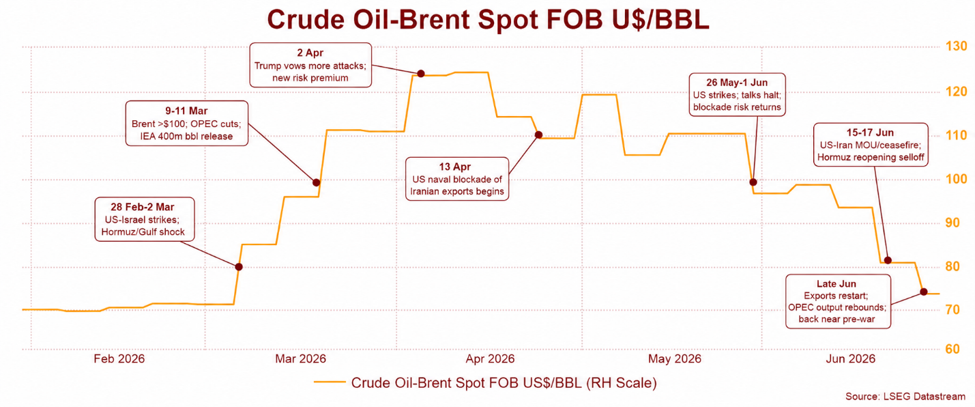
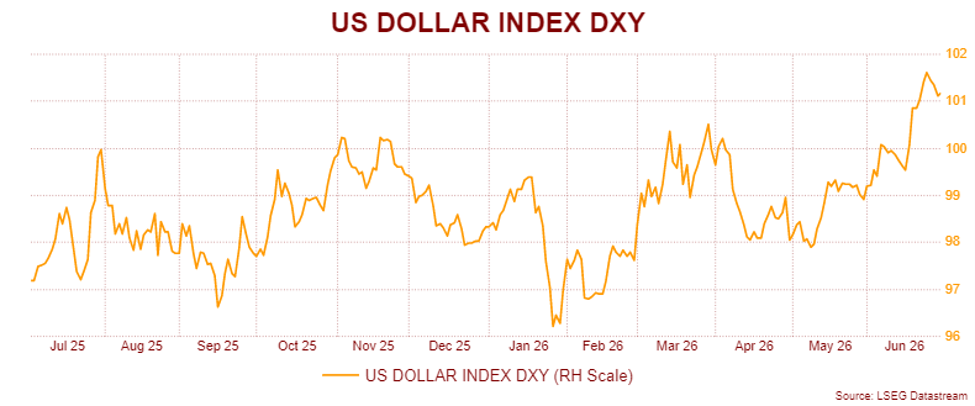
Markets closed weaker in June, as a seemingly hawkish shift in the US Federal Reserve’s interest rate policy stance offset a dramatic conclusion to the Iranian conflict. Markets cheered the MOU signed on 17 June between the US and Iran which provided for a 60-day ceasefire extension, the reopening of the Strait of Hormuz, and the lifting of the US naval blockade. This relief was short-lived, as the FOMC concluded its first meeting under new Chair Kevin Warsh with a hawkish set of rate projections. The chain of events resulted in varying consequences. While Brent crude fell 20.78%, its sharpest monthly decline since 2020, the US Dollar Index gained 2.30% along with an 11.65% decline in gold.
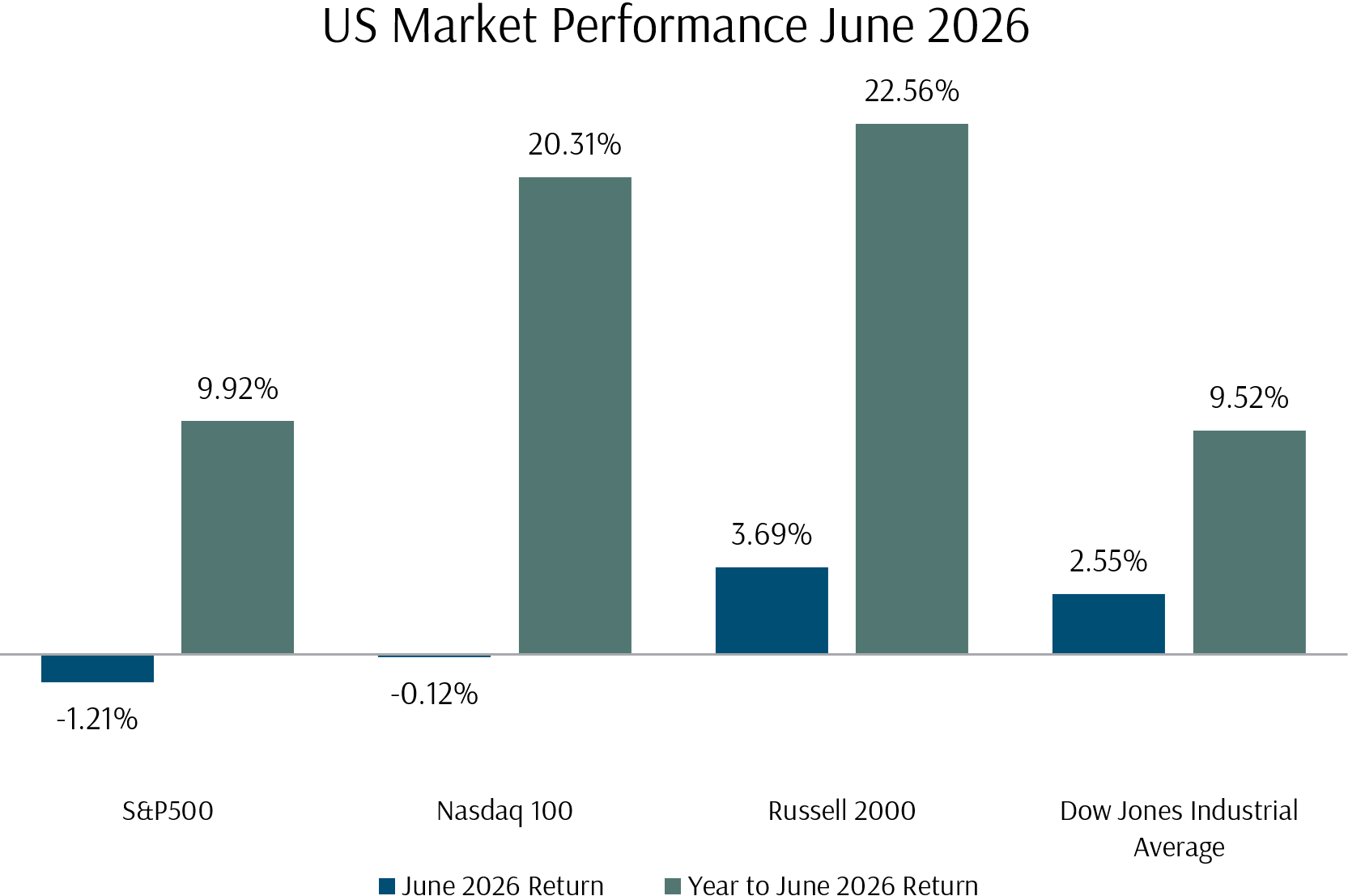
In equity markets, weaker headline indices masked a broadly positive month beneath the surface. The S&P 500 fell 1.21%, ending the nine-week winning streak that ran through May, yet eight of the eleven sectors posted positive returns. The Russell 2000 gained 3.69%, and industrials, healthcare, and financials led, while the Magnificent Seven and the software sector recorded declines of about 10%.
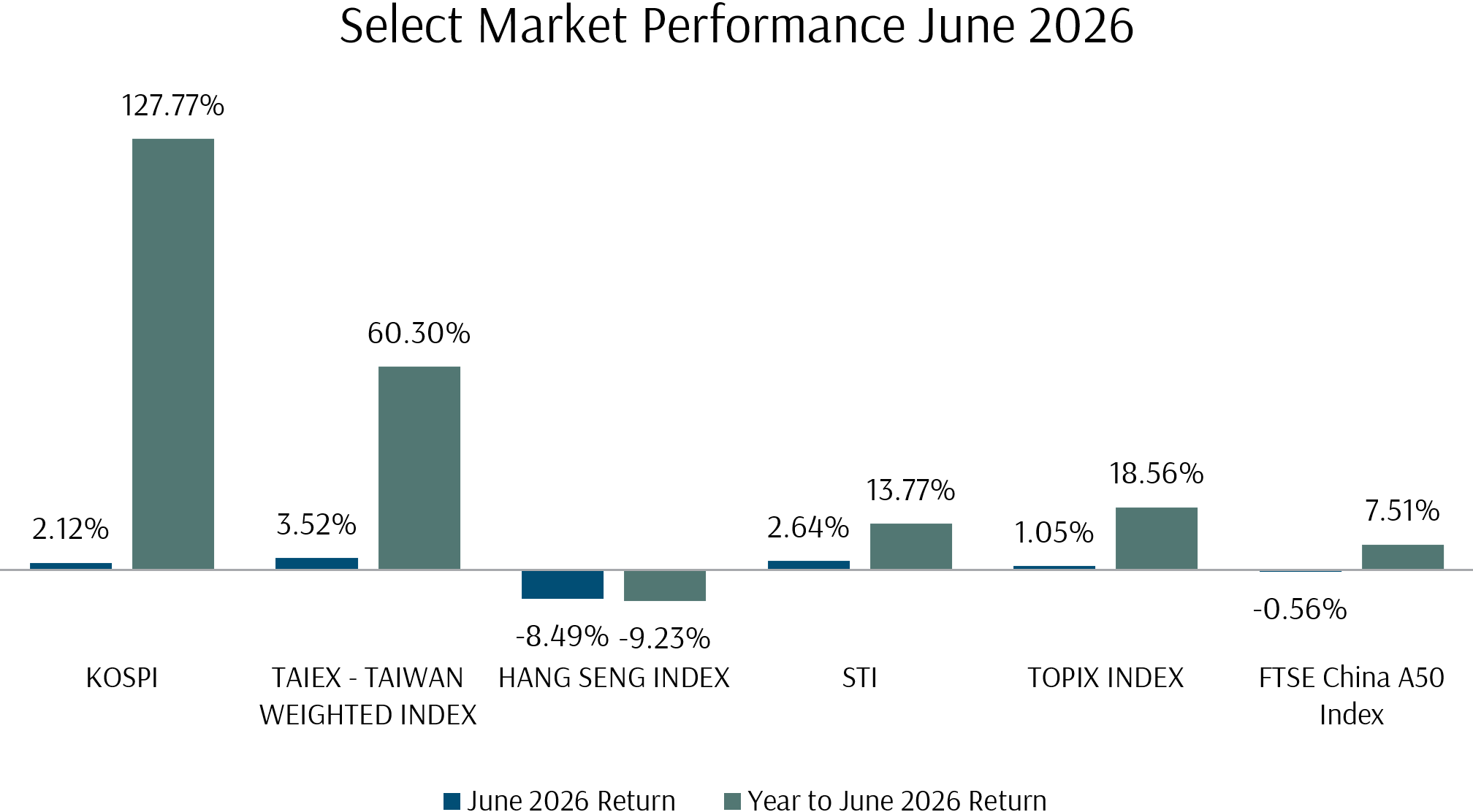
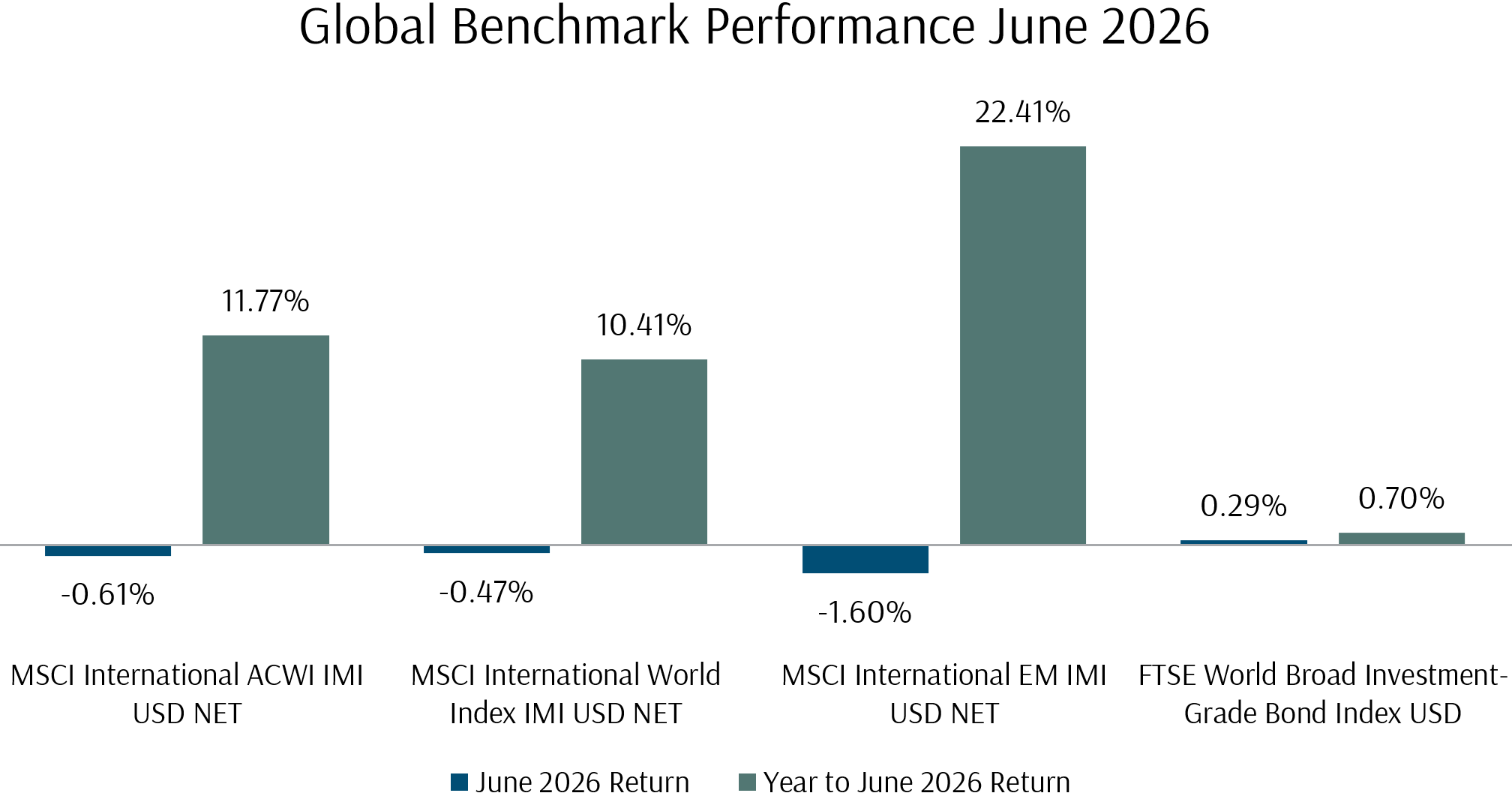
The broadening of market leadership away from mega-cap technology was generally a positive development for value and small-cap factors. In Asia, the KOSPI rose 2.12% and Taiwan’s TAIEX gained 3.52% as the semiconductor cycle continued to drive earnings, while Hong Kong’s Hang Seng fell sharply, declining 8.49% on weak domestic demand. Globally, the MSCI All Country World IMI returned -0.61%, its first negative month since January, and the MSCI EM IMI declined 1.60%, with the stronger dollar weighing on EM currency returns.
While observers may have expected a more positive reaction to the Iran conflict resolution, Brent oil prices had already fallen 19.26% in May as ceasefire speculation gained traction, and equities rallied to record highs over the same period, so the signing of the MOU on 17 June merely confirmed what markets had progressively discounted over the preceding six weeks.
Hawkish FOMC projections released the same day also shifted attention from geopolitics to rates. While the Fed held rates at 3.50% to 3.75%, the Committee’s 2026 median expectation for interest rates rose to 3.8% from 3.4% in March, with half the Committee signalling at least one hike. Core inflation projections were also revised higher to 3.3% for 2026. Markets subsequently priced in one 25 basis point hike by October 2026. While bond markets appeared to take the Fed’s projections in stride, with the US 10-year yield falling by 3 basis points through the month, the Fed’s hawkish tilt was transmitted primarily through the currency market. The US Dollar Index gained 2.30% in June, reaching its highest level in over a year.
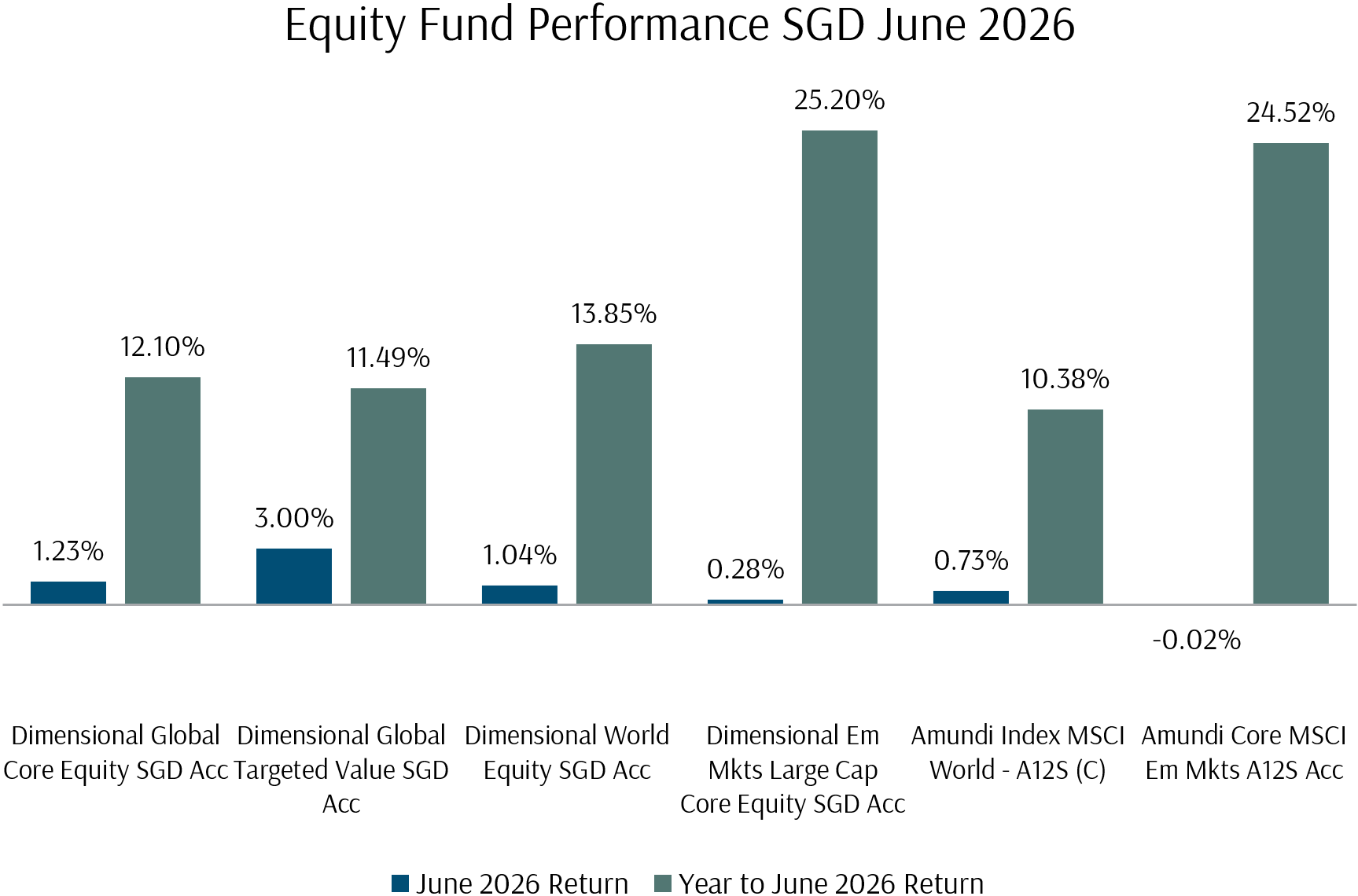
Providend factor-tilted portfolios outperformed market indices in June. The DFA Global Targeted Value Fund returned 3.00% in SGD terms and the DFA Global Core Equity Fund returned 1.23%, both ahead of the Amundi MSCI World Index Fund’s 0.73%. Emerging market fund returns were largely flat in SGD terms as the stronger dollar offset local market gains, and fixed income funds also contributed to balanced portfolios with positive returns.
This month’s investment questions cover the second half outlook and the AI cycle. We address what the Iran deal means for oil prices, inflation, and the Fed and whether the earnings behind the AI hardware trade are sustainable.
The macro environment entering the second half is more constructive than three months ago. Lower oil prices, stabilising global growth at about 2.5%, and the continued AI capital expenditure cycle all support equities, with the Q2 earnings season in July being the next test. Asian markets led by semiconductor exporters are expected to remain the strongest region, and the broadening of returns into value, small-cap, and industrials supports the case for diversified, factor-tilted portfolios.
Equity Market Performance
US Equities
The S&P 500 declined 1.21% in June, ending the nine-week winning streak from May. The Nasdaq 100 was roughly flat at -0.12%.
The past month’s highlight was the broadening of market leadership beyond the Magnificent Seven, which saw pronounced declines almost across the board, as rising memory prices triggered worries about the returns on their massive AI infrastructure developments. The memory factor also resulted in Apple raising its device prices significantly, resulting in a sharp sell-off in the stock.
In more positive news, the Russell 2000 gained 3.69%, industrials rose 7.25%, healthcare gained 6.61%, and financials added 4.30%. The software sector declined 10.86%, extending its year-to-date loss to 11.67%. In technology, semiconductors were the exception, with the Semiconductor Index up 9.51% and now up 72.29% for the year.
The FOMC held rates at 3.50% to 3.75% at Chair Warsh’s first meeting on 17 June. The vote was unanimous at 12-0, but the dot plot drew attention. The 2026 median rate projection rose to 3.8% from 3.4% in March, with nine of eighteen officials signalling at least one hike. Inflation projections were revised upward, with headline PCE at 3.6% and core PCE at 3.3% for 2026, while GDP growth was lowered to 2.2% and unemployment held at 4.3%. Markets priced in one 25 basis point hike by October following the meeting. CPI for May showed headline inflation at 4.2% year-on-year, driven by energy costs. Nonfarm payrolls came in at 172,000 in May with unemployment at 4.3%.
Exhibit 1: Us Stock Market Performance in June 2026 (USD)
International Equities
Asian markets continued to gain in June, though at a slower pace than prior months. Korea’s KOSPI rose 2.12% and Taiwan’s TAIEX gained 3.52%, extending year-to-date returns to 121.89% and 63.54% respectively. The AI semiconductor cycle continued to drive earnings and market performance across both markets. Japan’s TOPIX added 1.05%, supported by capital goods and tech hardware. Singapore’s STI gained 2.64%, with contributions from banks, industrials, and data centre-related names.
Greater China underperformed substantially. The Hang Seng fell 8.49% on weak domestic demand and renewed property sector stress. The FTSE China A50 was down 0.56%, although onshore A shares have fared better as investors pivoted from a property market still in the doldrums, with AI-related indices such as the STAR50 up for the year.
Exhibit 2: Select Market Performance in June 2026 (Local Currency)
Global Summary
The MSCI All Country World IMI returned -0.61% in June, its first negative month since January. The MSCI EM IMI declined 1.60%, with the stronger dollar weighing on USD-denominated returns. Year-to-date, the MSCI ACWI IMI is up 11.48% and the MSCI EM IMI is up 22.35%.
Exhibit 3: Global Equity Benchmark Index Performance in June 2026 (USD)
Cross-Asset Performance
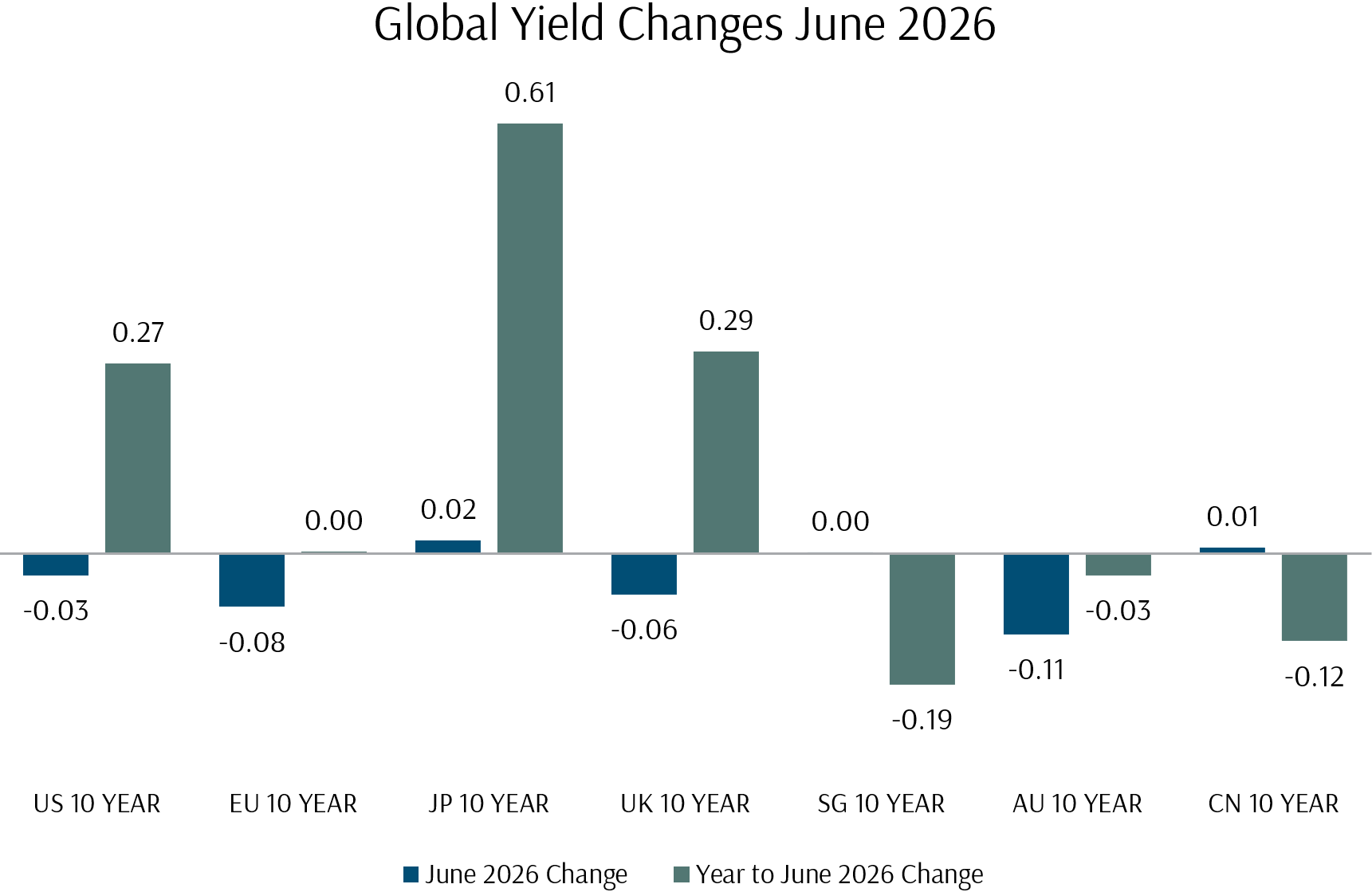
Fixed income markets were positive for the month. US 10-year yields fell by 3 basis points as the Iran deal eased inflation expectations. European yields fell more, with the EU 10-year down by 7.5 basis points and the UK 10-year down by 5.8 basis points. Australia saw the largest decline at 11.4 basis points. Japan’s 10-year yield rose by 1.9 basis points, continuing its upward trend from fiscal expansion and reduced central bank purchases. The FTSE World Broad Investment-Grade Bond USD Index returned 0.29%.
Exhibit 4: Global Yield Changes in June 2026
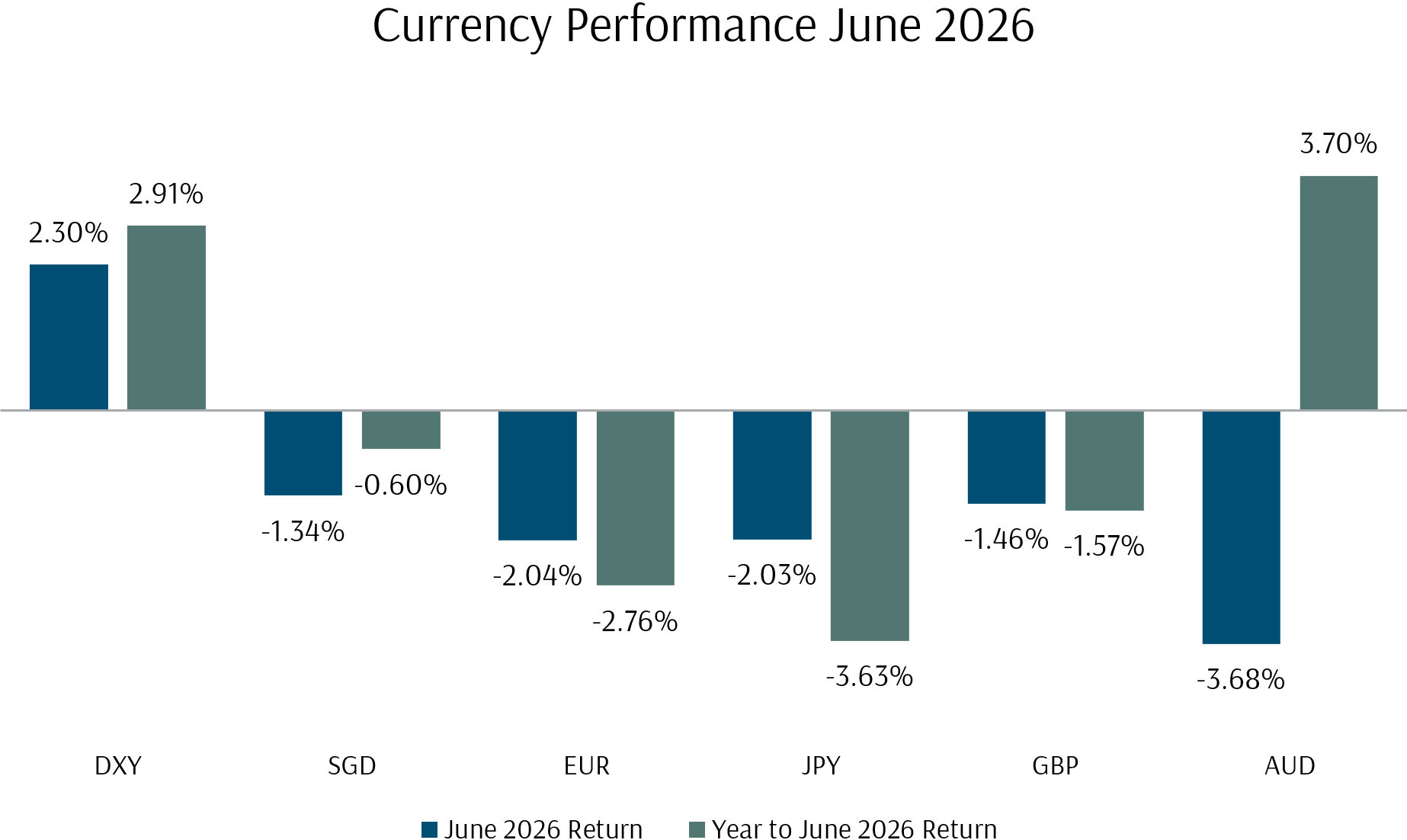
The US Dollar Index gained 2.30% in June, its strongest monthly move of the year, supported by the hawkish FOMC and resilient US economic data. This reversal was mirrored in other currencies, with the SGD weakening 1.34% against the dollar. The AUD was the weakest major currency, falling 3.68%, while the EUR and JPY both declined by about 2%.
Exhibit 5: Currency Performance in June 2026
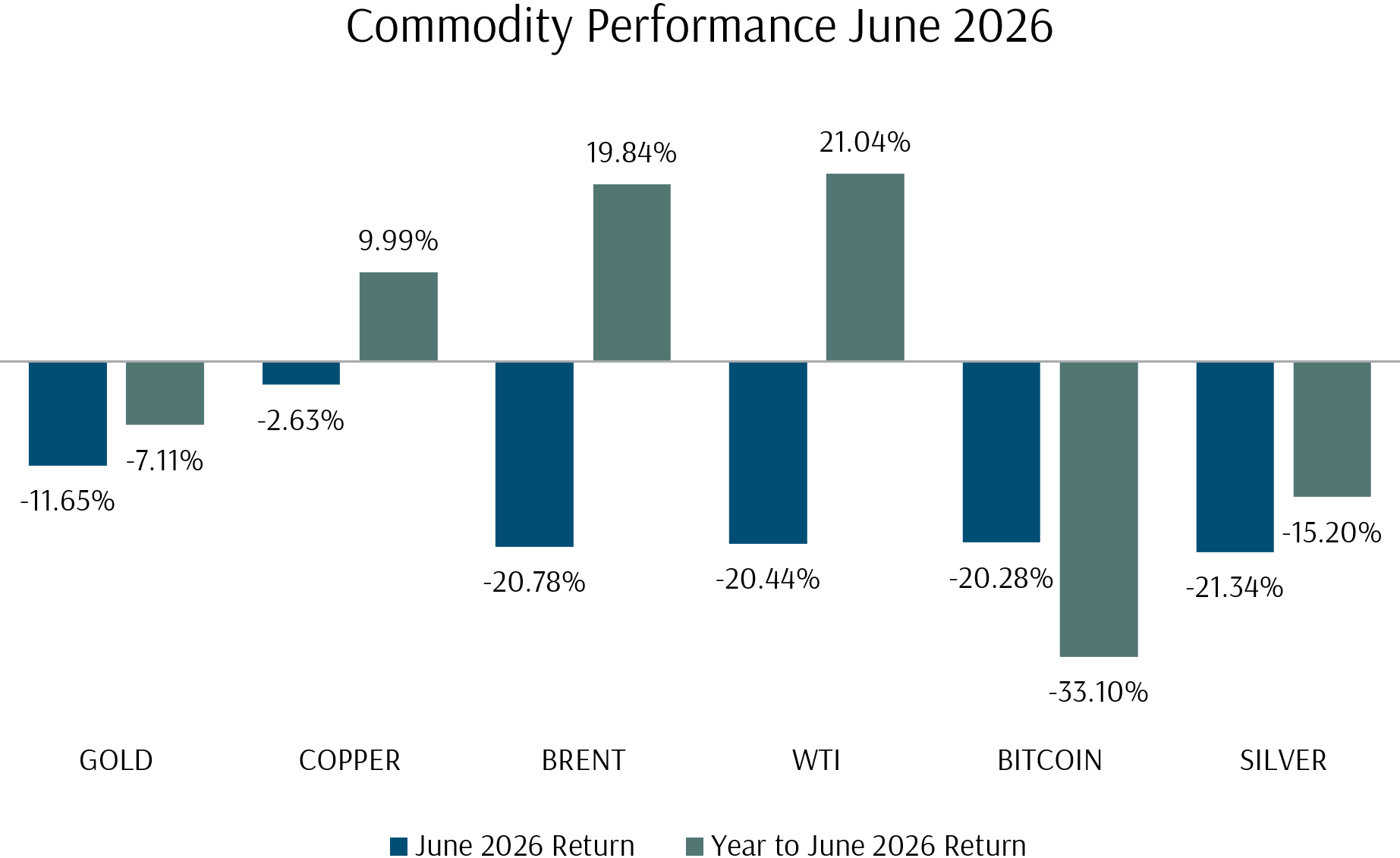
Brent crude fell 20.78% and WTI declined 20.44%, the sharpest monthly declines since 2020, as the reopening of the Strait of Hormuz removed the supply disruption premium. Oil price forecasts for the second half sit around $75 to $80 for Brent, with downside towards $60 to $65 over the next twelve months if a final deal is reached. Gold fell 11.65%, as reduced geopolitical risk, a stronger dollar, and rising real yields compressed the safe-haven trade. Silver declined 21.34% and copper was down 2.63%. Bitcoin fell 20.28%, extending its year-to-date decline to 31.49%.
Exhibit 6: Commodity Performance in June 2026
How Did Our Portfolio Funds Do in June?
Exhibit 7: Equity Fund Performance in June 2026 (SGD)
June was a constructive month for value and small-cap factors. The broadening of returns into industrials, healthcare, financials, and small caps aligned well with the factor tilts in our portfolios.
The DFA Global Targeted Value Fund returned 3.00% in SGD terms, well ahead of the Amundi MSCI World Index Fund’s 0.73%. The DFA Global Core Equity Fund returned 1.23%, also outperforming the index fund, reflecting the benefit of value and small-cap tilts in a month where these factors led. In emerging markets, returns were roughly flat in SGD terms as the stronger dollar offset local market gains. The DFA EM Large Cap Core Equity Fund returned 0.28%.
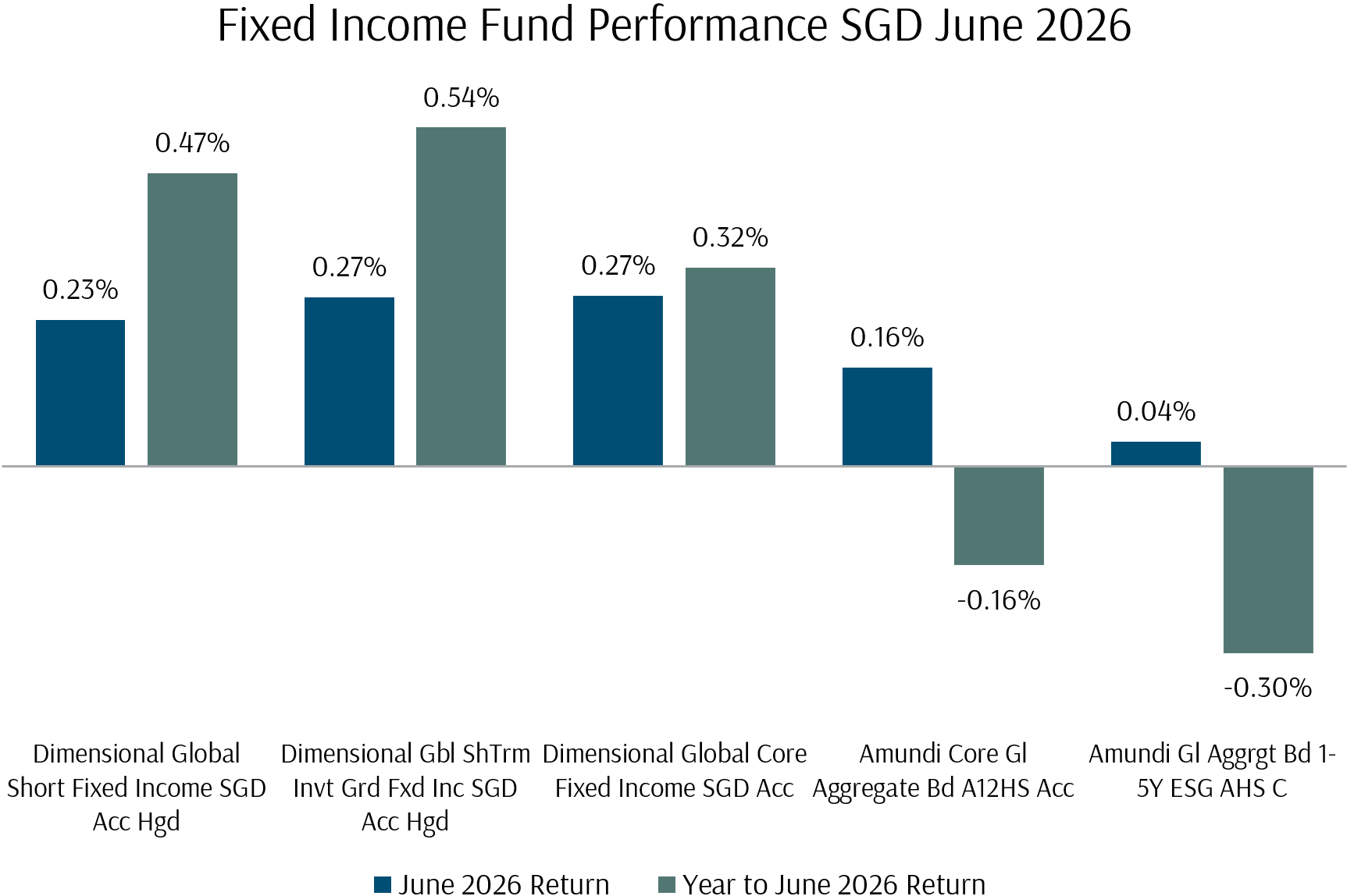
Fixed income funds delivered low positive returns. The DFA Global Core Fixed Income Fund gained 0.27% in SGD terms, while shorter-duration funds returned 0.23% to 0.27%.
Exhibit 8: Fixed Income Fund Performance in June 2026 (SGD)
Investment Questions: The 2H 2026 Outlook and the AI Cycle
Q1: How has the Iran deal changed the outlook for the second half?
The Islamabad MOU, signed on 17 June, provides for a 60-day ceasefire extension, the reopening of the Strait of Hormuz to commercial shipping, and the lifting of the US naval blockade. Oil prices have already repriced, with Brent below $75. If the deal holds and Hormuz flows normalise, oil forecasts suggest further declines towards $60 to $65 over the next twelve months. This has positive implications for inflation, growth, and monetary policy, particularly for energy-importing Asian economies.
Global growth estimates for 2026 sit at about 2.5%, down from 2.9% pre-conflict, with a rebound expected to about 2.8% in 2027. The macro environment has shifted from a supply shock to a broadly reflationary backdrop, which is constructive for equities.
The risk is that the deal is a framework, not a final settlement. Iran temporarily closed the Strait again on 20 June in response to Israeli strikes in Lebanon, and the US struck Iranian military targets on 27 June. A breakdown would reverse the recent repricing in oil and reintroduce inflationary pressure.
Q2: Will the Fed raise rates?
Markets are pricing in one 25 basis point hike by October. However, the incoming data does not clearly support a hiking cycle. Core CPI is below 3%, wage growth has decelerated, and the labour market is gradually softening, with June NFP coming in at 57,000 jobs versus a consensus expectation of 110,000 jobs. The inflation impulse has been driven by energy costs and, to a lesser extent, by rising prices for AI-related goods. With oil prices falling, headline inflation should ease over the summer.
The base case from several research houses is that the next Fed move will be a cut, with potential cuts beginning in October and reaching a 2.75% to 3.00% policy rate by early 2027. While these expectations might seem overly dovish in the aftermath of the latest Fed meeting, bond markets may have priced in more tightening than the data will ultimately support.
Q3: What is driving the AI trade, and are valuations sustainable?
The strongest returns in the technology sector continue to be concentrated in hardware, specifically in supply chain bottlenecks for memory chips, optical components, networking, power components, and the materials required to manufacture them. The largest hyperscalers are trading near or below their 10-year average valuations. Memory chip manufacturers have seen share prices more than triple this year, yet they still trade at low double-digit forward P/E ratios because the sheer magnitude of earnings growth has kept valuations from appearing excessive.
Software has been the opposite story. Valuations in the sector have been cut roughly in half since 2023, driven by a post-COVID slowdown in enterprise spending, rising operating costs, and concerns that AI could reduce the terminal value of traditional software businesses.
Across the Asian AI hardware supply chain, price-to-earnings-growth ratios remain reasonable in both absolute and relative terms for most subsectors. However, there is variation within subsectors, and expectations and valuations in some speculative segments have indeed reached bubble-like levels and carry a genuine risk of permanent loss. Fortunately, these segments are generally under-represented in broad market indices.
The next question is whether these earnings are sustainable. Historically, modest valuations in cyclical semiconductor names signalled earnings peaks, not buying opportunities. Whether the current AI cycle breaks this pattern depends on whether it delivers sustained productivity gains. Enterprise AI adoption remains at an early stage, with estimates suggesting only about 5% of US firms have fully deployed AI at scale. Demand for compute is estimated to grow more than 20-fold by the end of the decade, and if that materialises, the memory supply shortfall will persist through at least 2028.
Q4: Should investors worry about narrow market leadership and rising retail speculation?
Narrow breadth remains a concern. In the first half, just eight stocks accounted for over 95% of the regional Asian benchmark’s gains, and a similar pattern is evident in the US.
Retail speculation has increased, particularly in Korea, where assets in leveraged ETFs have grown from $5 billion at the start of the year to over $40 billion. This creates a pro-cyclical feedback loop, as dealer gamma hedging of these products amplifies volatility on both sides.
Investors who hold broad-market passive index exposure may not realise the extent of their effective technology concentration. As AI-related stocks have risen, their weights in index funds have grown. Factor-tilted funds, which overweight value, profitability, and small-cap exposures, hold different stocks and sector weights than standard index funds. This provides a natural offset to unintended sector concentration. June’s return pattern, where small-cap, value, and industrials outperformed mega-cap growth, is an illustration of why diversification across factors over full market cycles is highly recommended at this juncture in the market cycle.
Q5: What does this mean for our portfolios?
The first half of 2026 has delivered positive returns across our portfolios, benefiting from strong equity markets through the period. Year-to-date, the DFA Global Core Equity Fund has returned 11.82% and the DFA Global Targeted Value Fund has returned 11.63% in SGD terms. Emerging market exposure has been the strongest contributor, with the DFA EM Large Cap Core Equity Fund up 22.41%, driven by the Asian semiconductor cycle. Factor performance has varied month to month, as we would expect, but the cumulative pattern of value and small-cap contributing incremental returns over the index continues to hold.
The shift in returns away from mega-cap growth and into broader market segments in June further reinforced the diversification benefits of factor-tilted portfolios.
Looking Forward to July 2026
The dominant event for equity markets in July is the Q2 earnings season in the US, which will provide further insight into whether the earnings growth driving markets can continue at the pace required to justify the scale of the AI buildout. Capex commitment announcements by the large technology companies will also be pivotal. The impact will also be felt in Asia, where the focus will be on whether hyperscaler capex commitments for the second half confirm the current spending trajectory and whether the memory supply shortfall persists.
The Iran situation appears to be largely resolved, yet remains a low-probability, high-impact wildcard. Since the MOU signing, the US struck Iranian targets on 27 June, and both sides have accused the other of violations multiple times. July will also see the FOMC meeting on 28 and 29 July, where the Committee will assess whether falling oil prices justify a continued hold. While interest rate markets may have remained sanguine on rates in the face of the Fed’s hawkish shift, a reversal in oil price declines will surely cement hawkish convictions.
Further out, the September Trump-Xi summit in the US will be closely watched for developments on trade, tariffs, and rare earth controls. The November US midterm elections and the expiry of the tariff pause agreed in South Korea may also influence the direction of markets later in the year.
For our portfolios, the combination of strong equity returns, improving breadth, and constructive factor performance supports continued diversification. Rate uncertainty and geopolitical risk remain, but the underlying fundamentals, including earnings growth, AI capital expenditure, and a gradually easing macro environment, are conducive for positive returns.
With a comprehensive plan already in place with your Client Adviser, covering near-term spending needs while allocating capital at a level of risk suitable for your longer-term goals, you can have the peace of mind to stay invested for the long term, allowing your wealth to compound and fulfil your ikigai. If you have any questions, please do not hesitate to reach out to your Client Adviser.
The writer of this market review, Glenn Tan, is Senior Portfolio Manager at Providend Ltd, Southeast Asia’s first fee-only comprehensive wealth advisory firm. He is also a CFA Charterholder and a Certified Financial Risk Manager (FRM).
For more related resources, check out:
1. Active Investing That Adds Value to the Client
2. Staying the Course: Investing With Confidence in Uncertain Times
3. Here’s Why We Charge a Higher Fee Than Robos
Download our Investment eBook titled “A More Reliable Way to Get Enough Investment Returns: Even During Times of Market Uncertainty” here.
With a minefield of financial misinformation out there, we promise to be a safe pair of hands and a second pair of eyes to help you avoid costly financial mistakes. Learn more about our investment philosophy here.
We do not charge a fee at the first consultation meeting. If you would like an honest second opinion on your current estate plan, investment portfolio, financial and/or retirement plan, make an appointment with us today.