

July Market Summary
Global indices were broadly flat in July, despite sharp moves across sectors and countries. A reassessment of AI infrastructure spending, the return of the Iranian conflict, and a new regime at the Federal Reserve combined to produce one of the widest dispersions in recent years. The MSCI All Country World IMI fell 0.26% and the S&P 500 rose 0.19%, yet semiconductor shares fell about 18%, Korea’s KOSPI fell 23.61%, Brent crude rose 23.59%, and Hong Kong’s Hang Seng rose 13.46%. Global bond yields rose sharply, with the US 10-year up 32.3 basis points.
In equity markets, flows were largely dominated by a sharp rotation out of AI-related stocks globally, triggered by a trifecta of large stock offerings in the space, financial results that missed earnings expectations, and forced liquidations reverberating through an overleveraged investor base. Most dramatically, late in the month, an AI-focused hedge fund running at about four times leverage received margin calls and sold its entire public equity portfolio to Citadel in a single block trade, essentially losing the entirety of its public book. Over the tumultuous two weeks, shares in the sector fell by 20-40%.
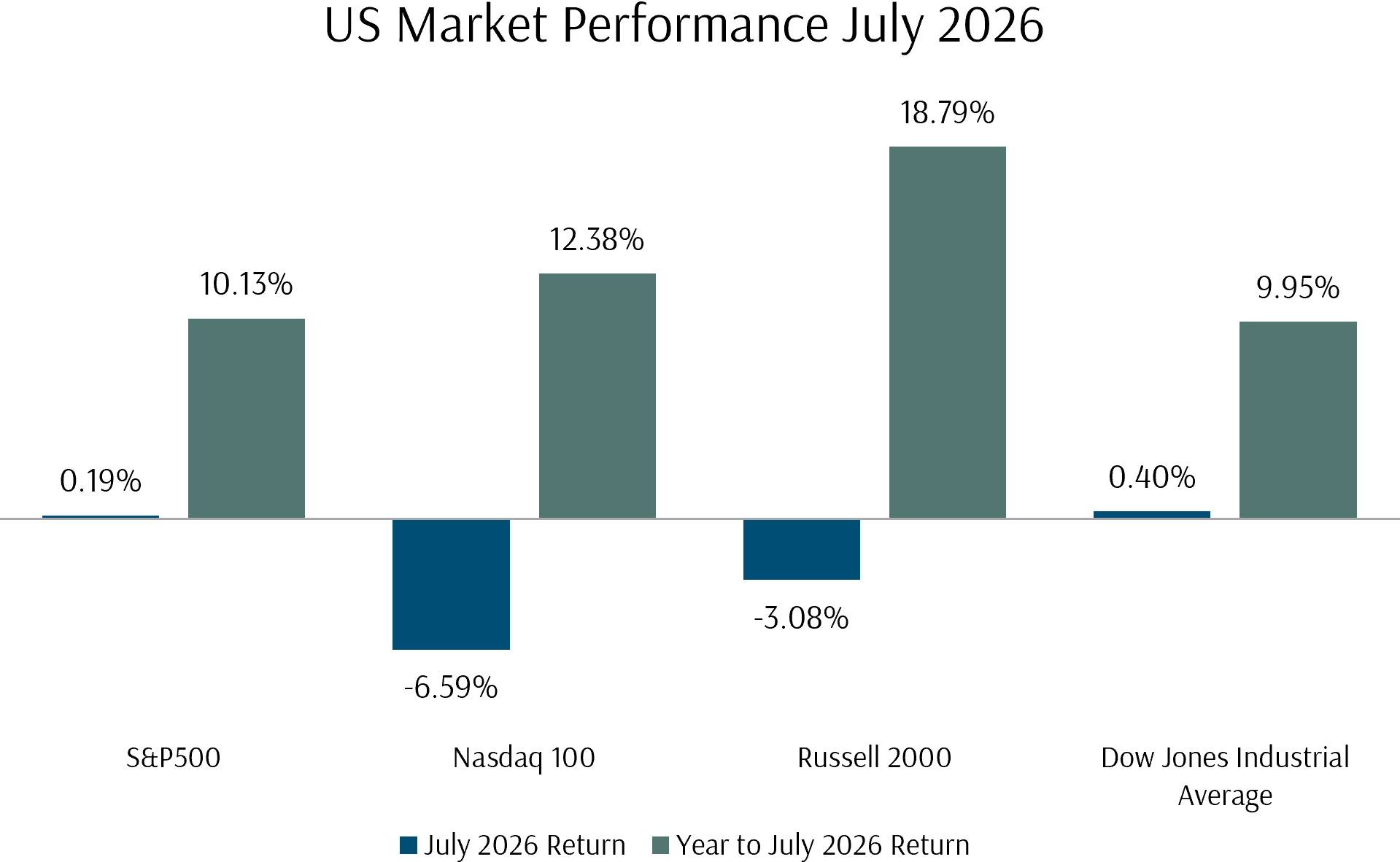
Despite the turbulence, headline indices were mixed. The S&P 500 rose 0.19% and the Dow Jones Industrial Average 0.40%, while the Nasdaq 100 fell 6.59% and the Russell 2000 fell 3.08%. Energy gained 12.13% and financials 6.21%, while the technology sector fell 7.96%. Within technology, software rose 4.39% while the Magnificent Seven big tech companies rose 2.58%.
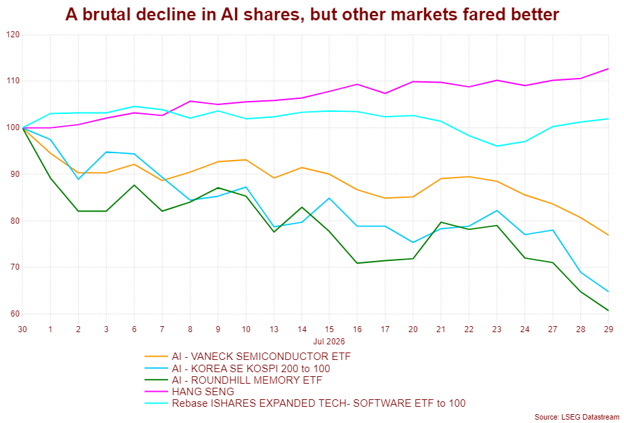
The rotation out of AI hardware was supportive of value and small cap factors. Both large and small cap value shares outperformed benchmarks. Other markets left behind by the prior rotation into AI, such as the Hong Kong’s Hang Seng Index, rose 13.46%. Singapore’s STI rose 9.06% to successive record highs as capital left the crowded semiconductor trade for cheaper, financial-heavy markets.
On the macroeconomic front, the Federal Reserve held rates at 3.50% to 3.75% on 29 July, marking a fifth consecutive hold. However, the committee’s vote was 9-3 in favour of holding, with all three dissenters wanting a 25-basis-point hike. Under Chair Warsh, the Committee has removed forward guidance altogether, so markets are left to work out the reaction function for themselves.
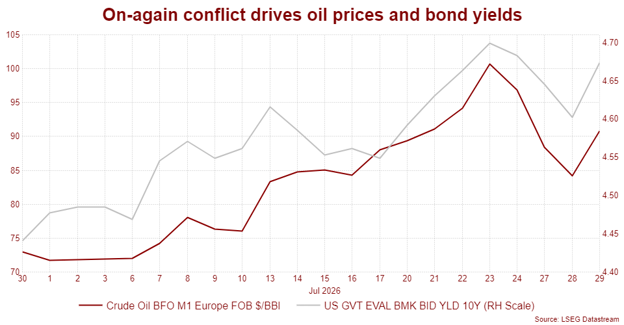
Higher oil prices drove the shift in rate expectations, as renewed US strikes on Iran from 8 July and disruption in the Strait of Hormuz took Brent up 23.59% and briefly above USD 100. Long-dated yields rose across most major markets, and the US Dollar Index fell 1.26%, with the yen gaining 3.17% after Japanese authorities intervened on 30 and 31 July with the US Treasury joining in coordinated action.
Providend factor-tilted portfolios again outperformed market indices in July. The DFA Global Targeted Value Fund returned 2.05% in SGD terms and the DFA Global Core Equity Fund returned 0.08%, both ahead of the Amundi MSCI World Index Fund at -0.25%. Emerging market funds lagged, with the DFA EM Large Cap Core Equity Fund down 5.78%. Fixed income funds declined modestly as yields rose, and the appreciation of the Singapore dollar reduced returns on unhedged SGD share classes by about 0.90%.
This month’s investment questions section examines the July sell-off in AI shares and the Federal Reserve: what caused the decline, whether the underlying businesses deteriorated, and why policy has become harder to read.
For diversified investors, July was less severe than the headlines and intraday price action suggested. Entering August, the AI complex has rebounded, and both the S&P 500 and the Dow have set record closes. Oil has fallen back below USD 80 on progress towards reopening the Strait of Hormuz, and attention has turned to the July employment, and inflation reports ahead of the September FOMC. Earnings growth rather than valuation expansion is driving returns, market participation has broadened well beyond the largest companies, and higher starting yields have restored the defensive function of the bond allocation.
Equity Market Performance
US Equities
The S&P 500 rose 0.19% in July and the Dow Jones Industrial Average 0.40%, while the Nasdaq 100 fell 6.59% and the Russell 2000 fell 3.08%. The index-level calm concealed sharp sector dispersion.
Energy led with a 12.13% gain on higher crude prices, followed by financials at 6.21%, healthcare at 2.45%, consumer staples at 2.38% and real estate at 2.36%. Technology was the clear laggard at -7.96%, with semiconductors down about 18% after leading the market for eighteen months. Industrials fell 2.91% and utilities 2.18%.
Performance within technology was highly uneven. Software rose 4.39% and the Magnificent Seven rose 2.58%, while the chipmakers and the debt-funded data centre operators fell heavily. Credit spreads on the more leveraged AI infrastructure borrowers widened sharply through the month.
The FOMC held rates at 3.50% to 3.75% on 29 July, but the 9-3 vote was significant in itself. Beth Hammack, Neel Kashkari and Lorie Logan all dissented in favour of an immediate 25-basis-point hike, the largest hawkish dissent in years. Accordingly, markets moved to price the September meeting as close to an even split between a hold and a hike. On economic data, June headline CPI fell to 3.5% year-on-year from 4.2% with core at 2.6%, a softer print than expected. Nonfarm payrolls came in at 57,000 in June with downward revisions to the two prior months, and unemployment held at 4.2%. Second quarter GDP growth slowed to 1.5% annualised, though underlying private domestic demand accelerated to 3.9%.
Exhibit 1: US Stock Market Performance July 2026 (USD)
International Equities
Asian markets accounted for both the best and worst major-market returns globally, driven by the AI rotation.
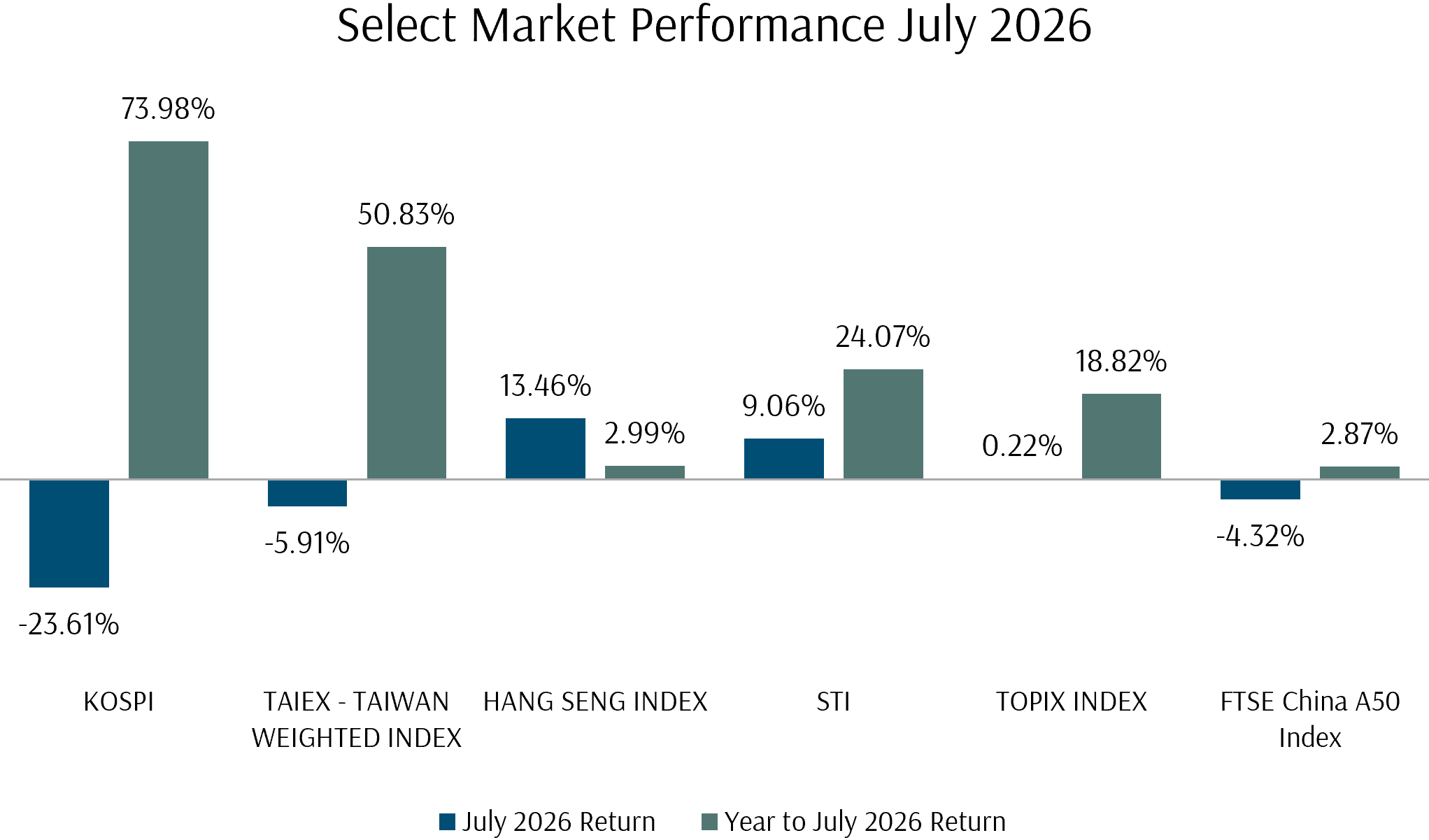
Korea’s KOSPI fell 23.61%, its weakest month on record, and at its intramonth low was down about 40% from June’s peak, a result of the unfortunate combination of concentration compounded by leverage. Two memory chipmakers make up more than half of the index by market value, and leveraged single-stock funds investing in those two names, launched only in late May, had attracted very large retail inflows within weeks. Daily rebalancing in those products resulted in mechanical forced selling as prices fell. Circuit breakers were triggered four times during the month, and the finance minister had to apologise to parliament.
Despite the volatility, semiconductor exports were up nearly 200% year-on-year in June, and both Samsung Electronics and SK Hynix reported record quarterly profits during the month, pointing to the decline as a positioning event rather than any sort of fundamental deterioration. The index rose 17.91% on 31 July, its largest single-day gain on record.
Taiwan’s TAIEX fell 5.91%, a modest index move that concealed a peak-to-trough decline of about 15%. TSMC reported a fifth consecutive record quarter and raised capital expenditure guidance for the third time, then fell on guidance for a lower gross margin in the following quarter. Japan’s TOPIX was flat at 0.22%, with heavy selling in semiconductor equipment makers offset elsewhere in old-school financials and staples.
Greater China diverged sharply between offshore and onshore. Hong Kong’s Hang Seng rose 13.46%, the strongest major market in the world for the month, as investors exiting crowded positions in the US, Korea and Taiwan moved into discounted Chinese internet platforms showing early evidence of AI monetisation. Hong Kong financial stocks had their best month in two years. Mainland A shares did not participate, with the FTSE China A50 down 4.32%, and China’s official manufacturing PMI unexpectedly fell back into contraction.
Singapore’s STI rose 9.06%, its best month in nearly six years, setting record highs repeatedly through July. Local banks drove most of the gain, supported by loan growth running ahead of deposit growth and continued strength in wealth and fee income, alongside a market composition that appealed to investors looking for stability and dividends in the midst of volatility.
Exhibit 2: Select Market Performance July 2026 (Local Currency)
Global Summary
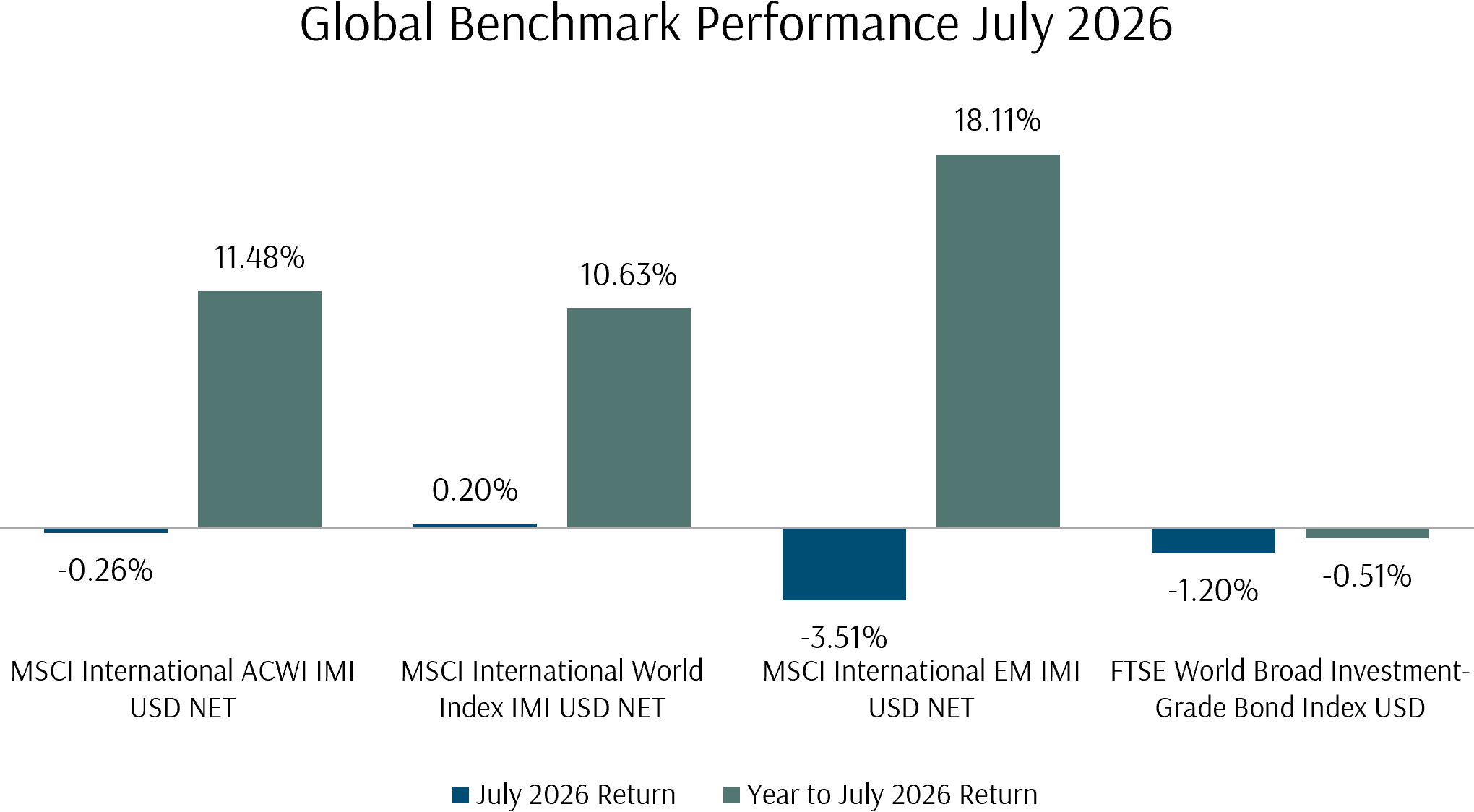
The MSCI All Country World IMI returned -0.26% in July and the MSCI World Index IMI returned 0.20%, while the MSCI EM IMI declined 3.51% due to its Korean and Taiwanese index weights. Year-to-date, the MSCI ACWI IMI is up 11.48% and the MSCI EM IMI is up 18.11%. Developed markets outside the United States outperformed.
Exhibit 3: Global Equity Benchmark Index Performance July 2026 (USD)
Cross-Asset Performance
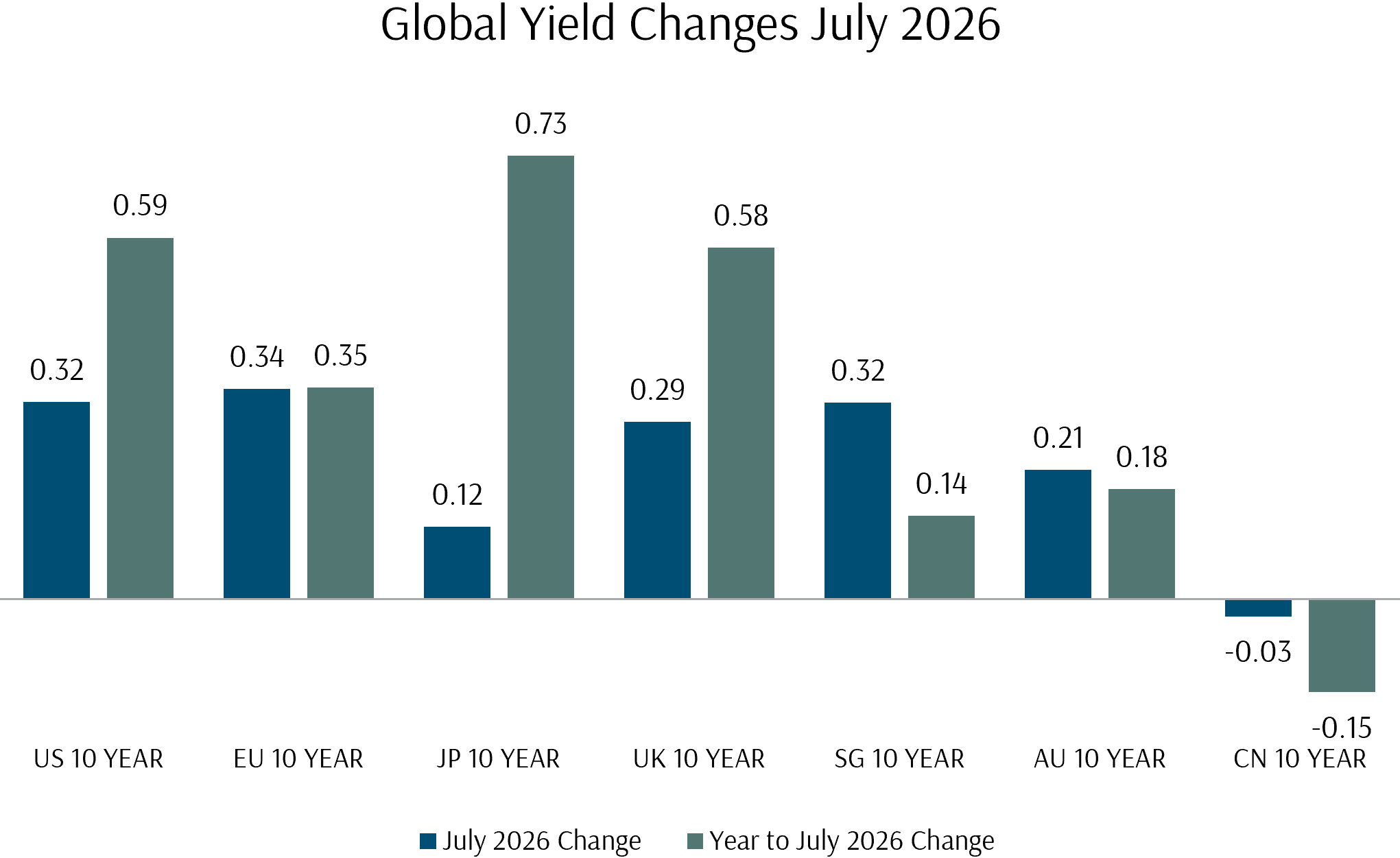
Fixed income markets sold off through July, and the move was observed across developed markets. The US 10-year yield rose 32.3 basis points to finish above 4.70%, while the 30-year reached its highest level since 2007. Ten-year yields rose 34.4 basis points in Europe, 32.1 basis points in Singapore, 29.0 basis points in the United Kingdom, 21.1 basis points in Australia and 11.8 basis points in Japan. China was the exception, falling 2.9 basis points. The FTSE World Broad Investment-Grade Bond USD Index returned -1.20%.
The sell-off in bonds was driven by a combination of factors. Higher energy prices threatened to reverse the disinflation of recent months in every major economy. Government issuance continued at the levels required to fund defence and ageing populations, with the US deficit running above USD 1.4 trillion through the first nine months of the fiscal year. Expectations also shifted towards tighter policy in Europe and Japan, where euro area inflation rose to 2.9% in July and Japanese short-dated yields reached levels last seen in the mid-1990s.
Exhibit 4: Global Yield Changes July 2026
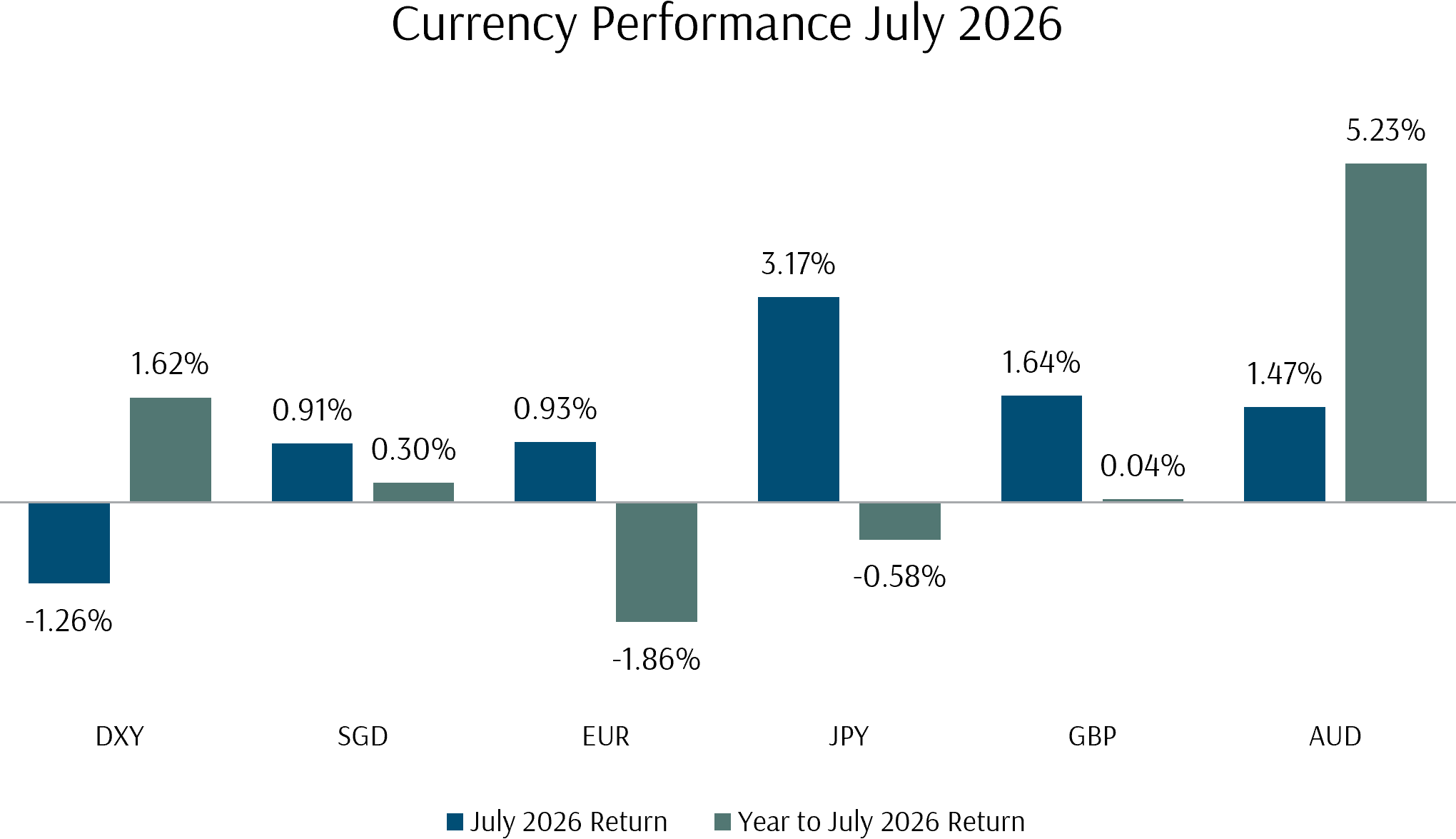
The US Dollar Index fell 1.26% in July, reversing part of June’s gain, and the SGD appreciated 0.91% against the dollar. The yen rose 3.17%, the largest move among major currencies, after Japanese authorities intervened on a large scale, with the US Treasury joining on 31 July in the first coordinated intervention of its kind in more than a decade. The yen had reached its weakest level against the dollar since 1986 as the gap between Japanese and US policy rates continued to support carry trades.
Exhibit 5: Currency Performance July 2026
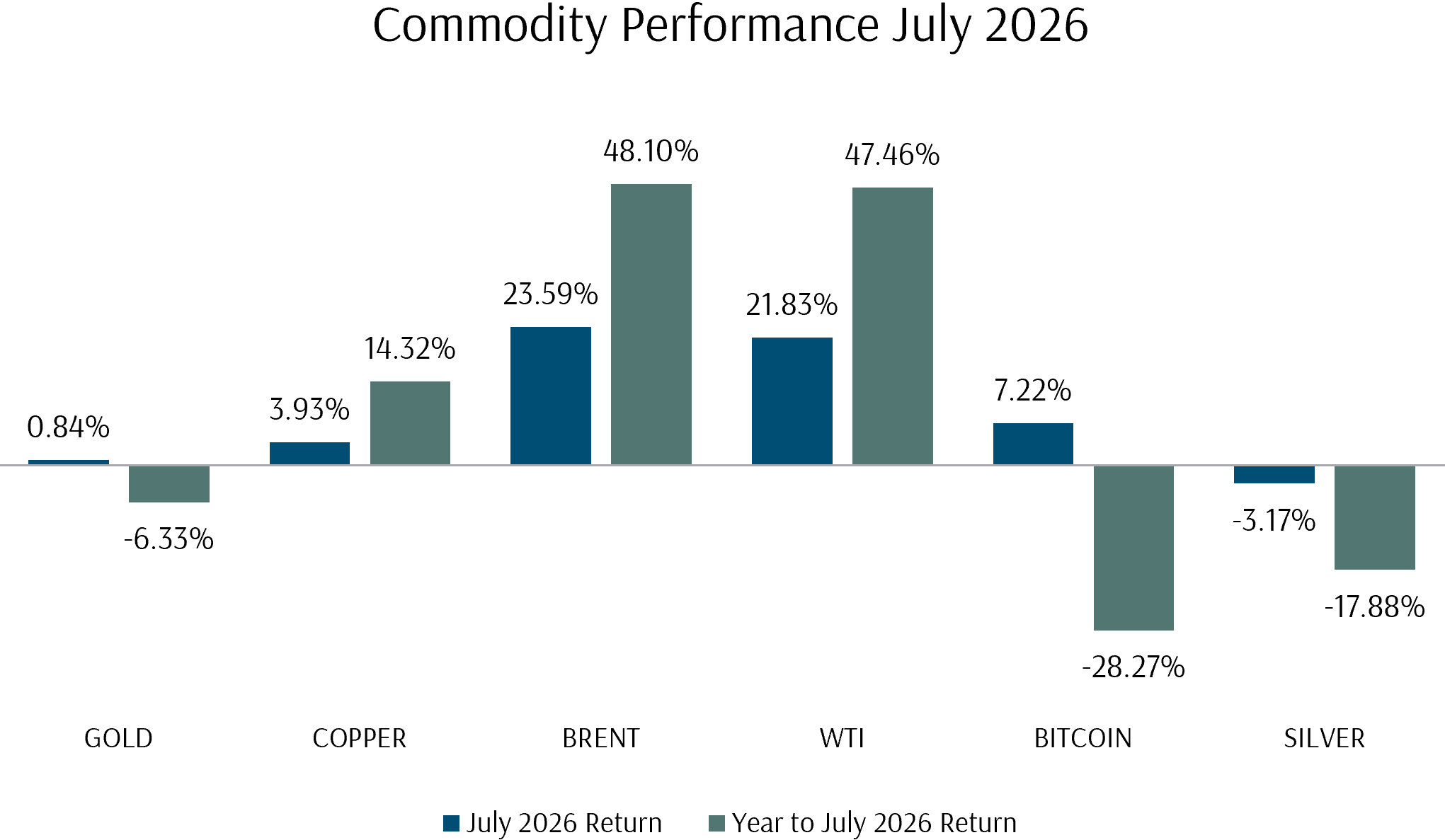
Commodity markets were dominated by crude oil, which reversed June’s decline entirely. Brent rose 23.59% and WTI 21.83% as US strikes on Iran resumed on 8 July, three commercial vessels were attacked in the Strait of Hormuz, and Brent traded above USD 100 late in the month. Flows through the Strait have been running well below pre-conflict levels. Copper rose 3.93% and Gold rose 0.84%, its first monthly gain since February. Bitcoin rose 7.22%, recovering a small part of a year in which it remains down 28.27%.
Exhibit 6: Commodity Performance July 2026
How Did Our Portfolio Funds Do in July?
Exhibit 7: Equity Fund Performance July 2026 (SGD)
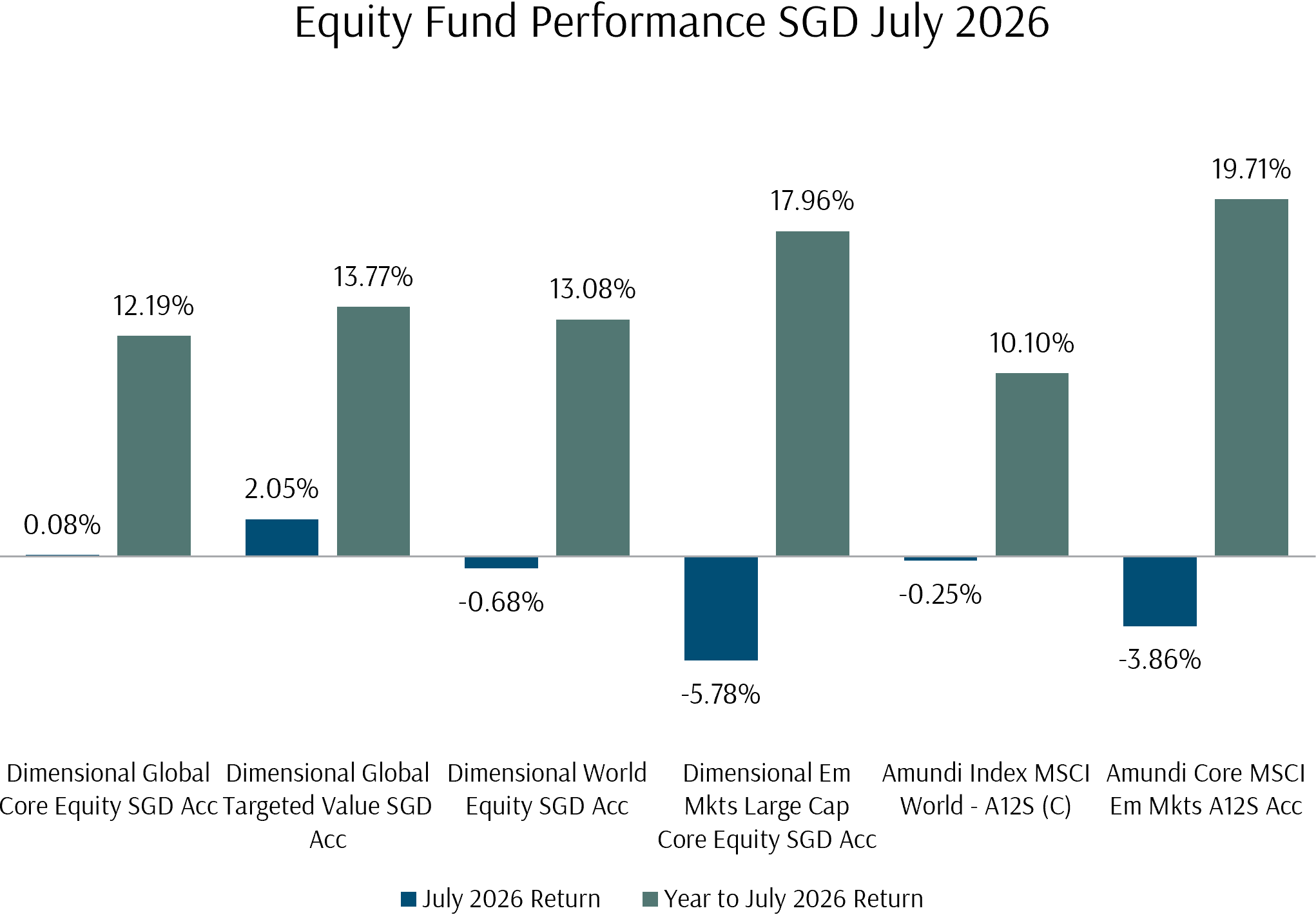
Value and small cap factors performed well in July even though global benchmarks were flat. The rotation out of AI hardware and into energy, financials, healthcare and real estate aligned well with the factor tilts in our portfolios.
The DFA Global Targeted Value Fund returned 2.05% in SGD terms, well ahead of the Amundi MSCI World Index Fund at -0.25%. The DFA Global Core Equity Fund returned 0.08% and the DFA World Equity Fund -0.68%.
Emerging market funds lagged. The DFA EM Large Cap Core Equity Fund returned -5.78% and the Amundi Core MSCI EM Fund -3.86%, attributable to larger weights in Korea and Taiwan. Nevertheless, both funds remained solidly positive for the year.
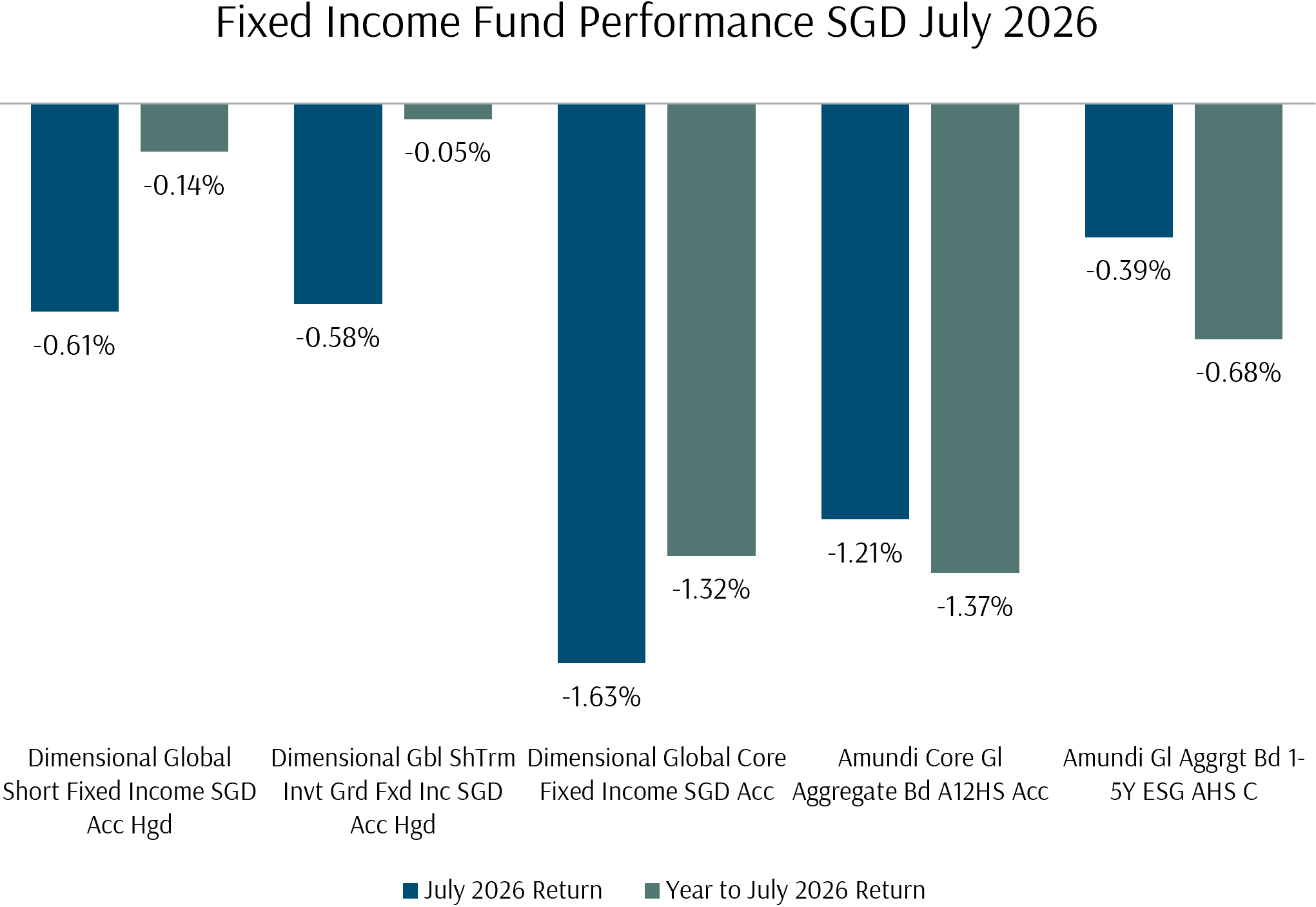
Fixed income funds declined as yields rose. The DFA Global Core Fixed Income Fund returned -1.63% in SGD terms, while shorter-duration funds were less impacted, returning -0.58% to -0.61%.
Exhibit 8: Fixed Income Fund Performance July 2026 (SGD)
Investment Questions: The July AI Selldown and the New Federal Reserve
Q1: What caused the sell-off in AI and semiconductor shares?
The sell-off was triggered by a number of factors: Meta opened July by announcing it would lease out spare data centre capacity, which appeared to undermine the assumption that computing power was permanently scarce. Moonshot AI then released Kimi K3 on 16 July, a 2.8 trillion parameter open-weight model scoring within about three points of the leading closed systems on the Artificial Analysis intelligence index, which weakened the assumption that frontier capability could remain proprietary for a long time.
Supply then arrived, first in stock and later in chips. SK Hynix listed 177.9 million ADRs on the Nasdaq on 10 July at USD 149 each, raising USD 26.5 billion in the largest first-time US share sale ever completed by a foreign company, which added new equity supply to a trade that was already crowded. CXMT, the fourth-largest DRAM maker at about 8% of the market, then listed on 27 July, and reports that Apple was testing its chips brought forward expectations of Chinese competition, with memory chip companies falling double digit percentages. SK Hynix then missed second-quarter revenue estimates on 28 July, which was read as an early sign of a cycle, although the company later clarified that this was due to change in product to higher margin HBM memory products, with revenues to pick up in subsequent periods.
However, industry data was less conclusive about any impending peak. Goldman Sachs estimated supplier inventories of DRAM and NAND at two to four weeks, below the normal four to five weeks, and expected demand for high-bandwidth memory to remain above supply in 2027. It also reported that long-term agreements were becoming longer, covering more production and including price floors, advance payments and firmer purchase commitments. These estimates did not rule out weaker pricing or lower margins, but they did not point to an imminent industry downcycle.
Selling pressure intensified late in the month. An AI-focused hedge fund using about four times leverage received margin calls and sold its public-equity portfolio to Citadel in a single pre-market block trade on 30 July. In Korea, retail investors also held large positions in leveraged single-stock products linked to the two largest memory-chip companies. Their daily rebalancing requirements added to selling as prices fell.
After the block trade cleared, several of the affected shares rose by between 18% and 27% intraday, while the Korean market recorded its largest one-day gain on record.
Q2: Did the underlying AI businesses get worse?
Available evidence suggests they did not. Cloud revenue growth at the largest platforms accelerated during the second quarter, and contracted future commitments grew faster still, which points to demand running ahead of the capacity available to serve it. Cash returns on capital invested across those businesses were unchanged. The two Korean memory manufacturers both reported record quarterly profits, one at an operating margin above 75%, and Korean semiconductor exports were up nearly 200% year-on-year in June. TSMC reported a fifth consecutive record quarter.
On the other hand, financial concerns are not entirely unsubstantiated. The largest cloud companies are spending far more on capital projects than they are currently recognising as depreciation, which means a substantial depreciation cost may be sitting on balance sheets awaiting recognition in future profits. Free cash flow across the group has fallen sharply even as reported net income has risen, with one of the largest reporting its first negative quarterly free cash flow since listing and another seeing free cash flow fall by more than 90% year-on-year. Analyst estimates of future revenue for these companies are reasonably tightly clustered, while estimates of future depreciation are several times more dispersed, indicating uncertainty in estimates of future costs. Ultimately, the true extent of these depreciation costs will depend on AI token usage trends in the longer term.
Financing structure also explained much of the performance divergence among AI-related shares. Companies funding construction with borrowings rather than operating cash flow saw their credit spreads widen sharply during July, while platforms funding it from operating cash flow were spared. Over the next two years, the key question is whether the return on deployed capital justifies its cost. For now, the signs are positive: AI is already generating rapid revenue growth for the largest model providers, and hyperscalers have also reported excellent returns on their investments in AI data-centre investments.
Q3: What is happening at the Federal Reserve, and why is policy harder to read?
The Committee held at 3.50% to 3.75% on 29 July for a fifth consecutive meeting, with three members dissenting in favour of an immediate hike. The difficulty in reading policy is partly deliberate. Under Chair Warsh, the Committee has removed forward guidance, shortened its statement, reduced discussion of the outlook at press conferences, and is reported to be considering fewer meetings each year. The stated rationale is that markets should assess the economy on its own terms rather than through the lens of an anticipated policy response, or in the Chairman’s phrase, that they should learn to play the ball rather than the referee. However, participants in short-term interest rate markets price what they think the Committee will do, not what it ought to do. Removing information reduces the accuracy of those estimates. The practical consequences are longer lags between data and financial conditions, and more volatility in between. Part of July’s rise in long-dated yields is attributable to this uncertainty.
Investors should expect interest rate volatility to remain higher than it was during the decade of explicit forward guidance. Individual data releases will move markets more than they used to, and short-term market pricing of Federal Reserve policy should be treated as a weak signal.
Q4: What does this mean for our portfolios?
Our portfolios are diversified by geography, sector, size and style, and tilted towards value and smaller companies. In a month when a crowded trade in global markets unwound, this structure cushioned the impact, and limited exposure to the subsequent 40% AI drawdown. Year-to-date, the DFA Global Core Equity Fund has returned 12.19% and the DFA Global Targeted Value Fund 13.77% in SGD terms, with the DFA EM Large Cap Core Equity Fund up 17.96%.
Two broader trends bode well for our diversified and fundamentally-tilted portfolios. Returns across regions are now being driven by earnings growth rather than by rising valuations, marking a change from the fifteen years after the financial crisis. Market participation has also broadened, with the equally weighted S&P 500 outperforming the capitalization-weighted index by more than seven percentage points over a two-month window. Concentrated markets increase risk for investors even as they flatter index returns, whereas broader participation increases the relative benefit of diversification.
Looking forward to August 2026
Markets reversed course quickly as July ended. The AI complex rebounded in the first days of August, semiconductor and technology shares led the recovery, and both the S&P 500 and the Dow Jones Industrial Average set record closes on 3 and 4 August. Brokers have since reported significant deleveraging across previously crowded segments of the markets, with some estimating up to 70% reduction in gross leverage amongst their client bases. This will likely set the base for calmer markets in the following weeks, although the tech sector does remain prone to external shocks in an environment of rapid developments in AI.
Lower oil prices have also driven improvements in market conditions. Brent has fallen from above USD 90 at the end of July to below USD 80 as the United States and Iran moved towards an arrangement to reopen the Strait of Hormuz, with Oman and Qatar mediating. Planned strikes were called off in early August and negotiations resumed. Lower energy prices have taken the US 10-year yield down from its July high and have done much to ease expectations of tighter policy, although the same mechanism could reverse quickly if negotiations fail as neither side has signed an agreement.
The next key events are the July employment report on 7 August, July inflation on 12 August and the FOMC meeting on 15 and 16 September. Market pricing for that meeting is close to an even split between a hold and a 25-basis-point hike, with roughly one hike priced by the end of the year. Comments from the Jackson Hole symposium later this month will carry more weight than usual, given how little the Committee now says between meetings. Further out, the September Trump-Xi summit and the November US midterm elections remain on the calendar.
The factor tilts cushioned July’s decline, and our portfolios have participated in the early August recovery, with the equity funds up strongly in the first days of the month. Rate uncertainty and geopolitical risk remain, but broadening participation, improving earnings revisions and higher starting yields on the fixed income allocation underpin the outlook for positive returns for the rest of the year.
With a comprehensive plan already in place with your Client Adviser, covering near-term spending needs while allocating capital at a level of risk suitable for your longer-term goals, you can have the peace of mind to stay invested for the long term, allowing your wealth to compound and fulfil your ikigai. If you have any questions, please do not hesitate to reach out to your Client Adviser.
The writer of this market review, Glenn Tan, is Senior Portfolio Manager at Providend Ltd, Southeast Asia’s first fee-only comprehensive wealth advisory firm. He is also a CFA Charterholder and a Certified Financial Risk Manager (FRM).
For more related resources, check out:
1. Active Investing That Adds Value to the Client
2. Staying the Course: Investing With Confidence in Uncertain Times
3. Here’s Why We Charge a Higher Fee Than Robos
Download our Investment eBook titled “A More Reliable Way to Get Enough Investment Returns: Even During Times of Market Uncertainty” here.
With a minefield of financial misinformation out there, we promise to be a safe pair of hands and a second pair of eyes to help you avoid costly financial mistakes. Learn more about our investment philosophy here.
We do not charge a fee at the first consultation meeting. If you would like an honest second opinion on your current estate plan, investment portfolio, financial and/or retirement plan, make an appointment with us today.