

In the early hours of 1 October 2025 (local time), the US government officially shut down. This shutdown occurred primarily because the two major parties in Congress failed to reach an agreement on a “temporary appropriations bill”, leaving the federal government without funding for its operations — and thus in a predicament where it had no funds to operate. 1 October 2025 (local time) was the final deadline to reach a deal. While the Republican Party holds a majority in both the House of Representatives and the Senate, it only has 53 seats in the Senate. Under Senate rules, an appropriations bill requires 60 votes to pass. As a result, the Republicans cannot pass the bill on their own, and the two parties have struggled to reach a consensus, leading to a deadlock over funding.
Since 1976, the US government has shut down 20 times, though not all of these resulted in a full shutdown—half of the cases successfully averted a crisis. Before the 1980s, funding gaps usually did not significantly disrupt government operations; agencies would continue functioning under the assumption that funding would eventually be approved. However, the strict enforcement of the “Anti-Deficiency Act” in the early 1980s completely changed this: simply put, the government cannot operate on credit — once funding is cut off, it must “shut down operations.”
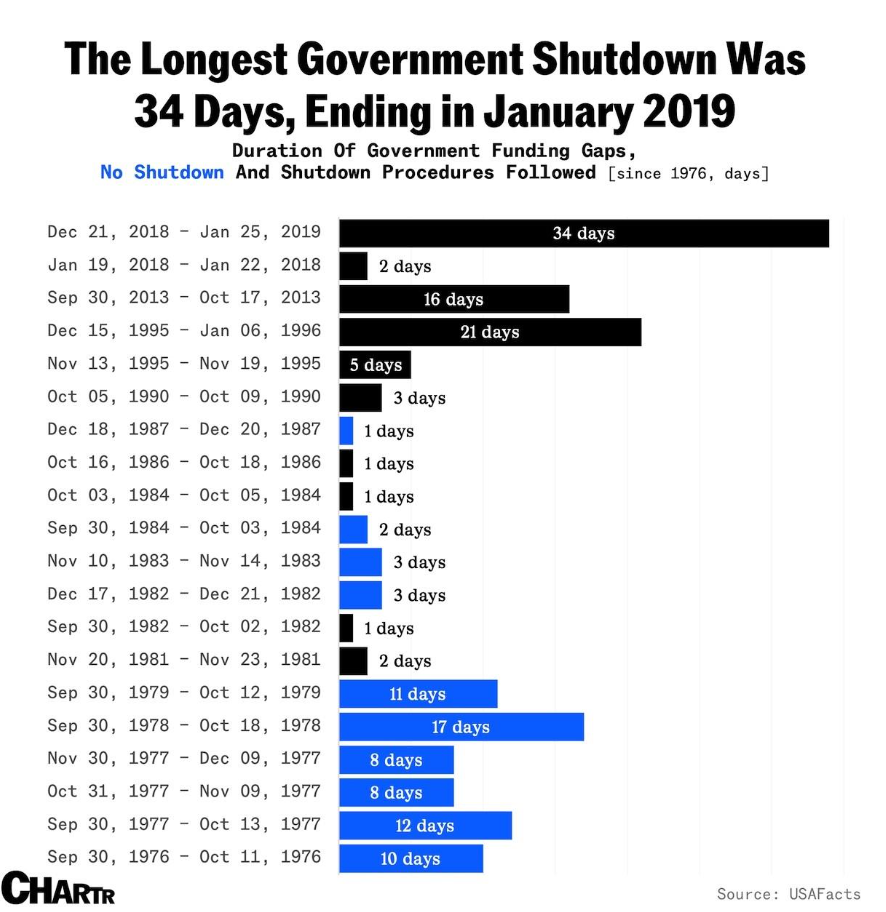
In recent years, funding gaps in the US have persisted. The duration of the current shutdown remains unclear, but the most likely solution is a “continuing resolution (CR)” — a measure that has ended every shutdown since 1990. A continuing resolution can be understood as a temporary agreement: essentially, it allocates funds based on the previous fiscal year’s budget to maintain normal operations until the two parties reach a formal consensus.
From a historical perspective, a government shutdown does not necessarily lead to a stock market decline. The 2013 US government shutdown had a certain impact on the stock market: market concerns spread, investor risk aversion rose, and the Dow Jones Industrial Average fell by more than 1.2% cumulatively. The VIX Index (which measures implied volatility for S&P 500 options) even surged to a two-month high, leading to a significant increase in market volatility.
In contrast, the 35-day shutdown from 2018 to 2019—the longest in US history—saw relatively stable financial markets, with stock prices even rising. The S&P 500 Index and Dow Jones Industrial Average gained 13.34% and 13.51% respectively, while the Nasdaq 100 Index rose by an even larger 15.69%. This was because the market believed private enterprises could continue operating normally during the shutdown, with little impact on their business, so no panic emerged.
At its core, a US government shutdown is a short-term disruption caused by political bargaining, not a fundamental deterioration of economic fundamentals. Investors should maintain “strategic composure”: on the one hand, they should adhere to long-term allocation logic and not deviate from their asset allocation goals due to short-term volatility; on the other hand, they should control risks through diversified investments. Historical experience shows that market volatility caused by political crises is both a test of long-term investors’ discipline and an inevitable challenge in the process of maintaining long-term asset allocation.
This is an original article written by Dr Peng Chen, Senior Advisor and Director at Providend, Southeast Asia’s first fee-only comprehensive wealth advisory firm.
For more related resources, check out:
1. Moods and the Market: How to Invest and Keep Investing
2. Principles for Successful Investing
3. Avoid These Mistakes in Equity Investing
Download our Investment eBook titled “A More Reliable Way to Get Enough Investment Returns: Even During Times of Market Uncertainty” here.
To ensure a good investment experience, Providend is committed to delivering reliable returns, prioritising this over maximising returns and taking unnecessary risks that do not meet your needs. You can learn more about our purpose-driven approach towards Wealth Management and Investment Management.
We do not charge a fee at the first consultation meeting. If you would like an honest second opinion on your current investment portfolio, financial and/or retirement plan, make an appointment with us today.